Last updated: 2 November 2026
A branding agency contract is the legal document that sets out ownership of your logo and designs, payment milestones, revision limits and exit rights before any creative work begins. The single biggest risk is intellectual property: UK law means an agency keeps copyright by default unless a written assignment clause transfers it to you, so checking that clause first matters more than the price on the quote.
Key Takeaways
- UK copyright law defaults to the creator: a freelancer or agency retains ownership of the copyright and design right they create, even when the client has paid for the work, unless a written assignment is signed, according to LegalDocuments.co.uk (2025).
- Copyright assignments must meet a legal formality: UK law requires copyright assignments to be in writing and signed by or on behalf of the assignor under section 90(3) of the Copyright, Designs and Patents Act 1988, according to LegalDocuments.co.uk (2025).
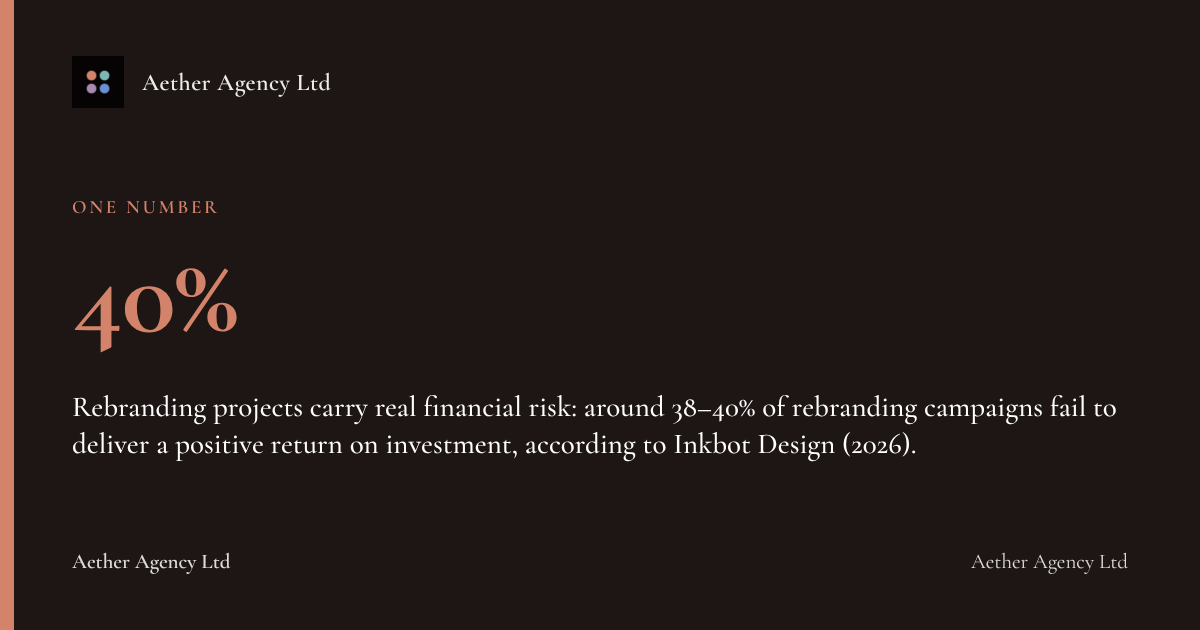
- Rebranding projects carry real financial risk: around 38–40% of rebranding campaigns fail to deliver a positive return on investment, according to Inkbot Design (2026).
- Unfair contract terms carry serious regulatory consequences: businesses found in breach can face a penalty of up to 10% of global turnover or £300,000, whichever is greater, according to the Competition and Markets Authority's Unfair Contract Terms Guidance (CMA37) (2025).
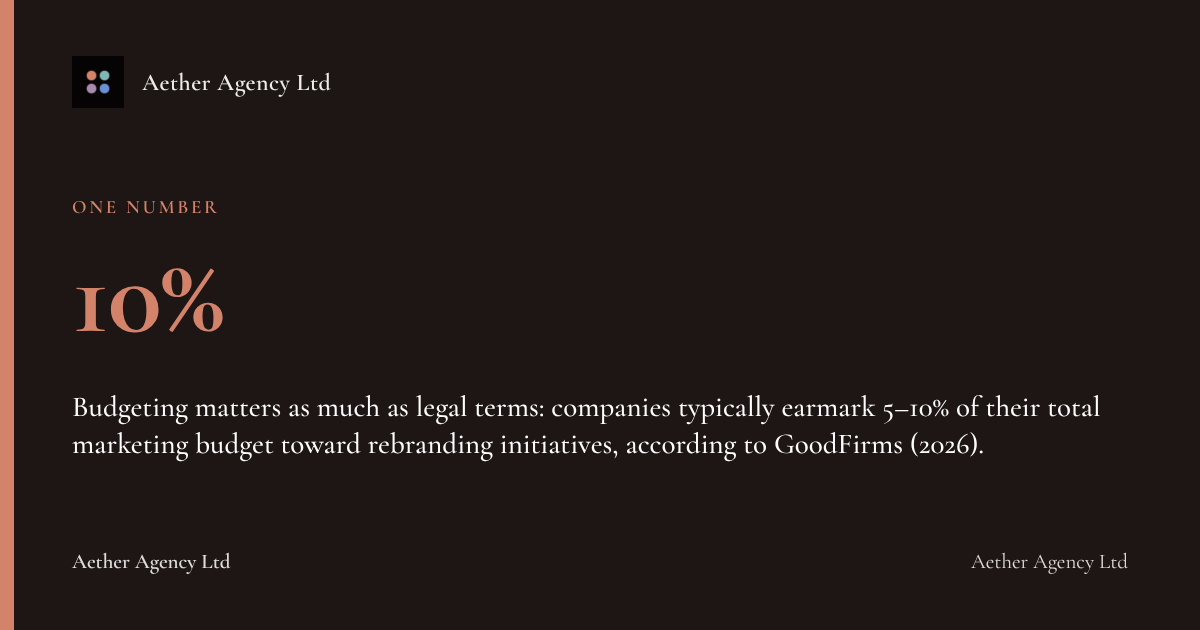
- Budgeting matters as much as legal terms: companies typically earmark 5–10% of their total marketing budget toward rebranding initiatives, according to GoodFirms (2026).
Who owns the intellectual property rights to branding deliverables?
Intellectual property (IP) ownership determines who legally controls your logo, brand identity and any registered trademark once a branding project finishes. Under UK law, a freelancer or agency retains ownership of the copyright and design right they create, even when the client has paid for the work, unless a written assignment is signed, according to LegalDocuments.co.uk (2025).
This catches out more businesses than almost any other clause in a branding agency contract. Paying an invoice does not automatically transfer ownership — the contract must contain an explicit assignment clause, and that assignment must be in writing and signed by or on behalf of the assignor under section 90(3) of the Copyright, Designs and Patents Act 1988 (CDPA), according to LegalDocuments.co.uk (2025).
Check whether the contract offers a full assignment (you own everything outright) or a licence (you only have permission to use the work, often with restrictions on scope, territory or duration). A licence is cheaper for the agency to offer but weaker for you — it can limit your ability to register the logo as a trademark with the UK Intellectual Property Office (IPO) or to sell the brand later as part of a business disposal.
Ask the agency to warrant that the final designs are original and do not infringe a third party's existing trademark or copyright. This warranty, paired with an indemnity, protects you if a dispute surfaces after launch — a real risk given how closely some branding work can resemble existing marks. The CMS Law guide to transferring IP rights in the UK sets out the formalities that a properly drafted assignment should follow.
What project scope and deliverables should the contract specify?
Scope and deliverables are the written description of exactly what the agency will produce, in what formats, and by when — the clause that prevents scope creep. A vague scope is the fastest route to disputes, because "branding project" means different things to different agencies.
The contract should list every deliverable by name: primary logo, secondary logo marks, colour palette with exact Pantone and hex references, typography selections, brand guidelines document, social media templates, and any trademark search or filing support. It should also state file formats (vector EPS, SVG, PNG) and usage rights for each — print, digital, merchandise, signage.
Specify what is explicitly excluded. Website build, copywriting, photography and paid media are often separate workstreams, and Aether Agency Ltd treats brand identity and website development as distinct services precisely because bundling them without clear boundaries invites confusion over who delivers what. A well-drafted scope document reduces the chance your project becomes one of the 38–40% of rebranding campaigns that fail to deliver a positive return on investment, according to Inkbot Design (2026) — unclear deliverables are a common driver of wasted spend.
How should payment terms, milestones and kill fees work?
Payment terms set out how much you pay, when, and what happens if either party ends the project early. Most UK branding agency contracts split payment into stages — typically a deposit on signature, a milestone payment at concept approval, and a final balance on sign-off or file delivery.
Check for a kill fee: the amount payable if you terminate the contract partway through. A fair kill fee reflects work genuinely completed, not a flat penalty designed to lock you in regardless of progress. Also check for late payment interest, which under UK law can default to the rates set out in the Late Payment of Commercial Debts (Interest) Act 1998 if the contract is silent.
| Payment stage | Typical trigger | What to check |
|---|---|---|
| Deposit | Contract signature | Usually 30–50% of total fee; confirm it's non-refundable only after work starts |
| Milestone 1 | Concept presentation | Tied to a dated deliverable, not a vague "progress" marker |
| Milestone 2 | Revisions complete | Should align with the agreed revision round limit |
| Final balance | Sign-off / file handover | IP assignment should trigger on this payment, not before |
Budget context matters too. Companies typically earmark 5–10% of their total marketing budget toward rebranding initiatives, according to GoodFirms (2026), which gives you a sense-check figure when an agency's quote seems disproportionate to your overall marketing spend.
What happens if the agency misses deadlines?
A timeline clause sets out the delivery date for each milestone and the consequence if the agency fails to meet it. Aether Agency Ltd advises that every branding agency contract should state concrete dates — not "4-6 weeks from kick-off" but calendar dates tied to each deliverable, because vague timeframes are unenforceable in practice.
Check whether the contract includes a remedy for missed deadlines: a service credit, a right to terminate without penalty, or simply silence. Silence favours the agency. Build in a grace period — commonly five to ten working days — after which you gain the right to withhold payment or exit without triggering a kill fee.
This matters more than it first appears. About 82% of marketers reported having worked on a rebranding project before, according to GoodFirms (2026). Aether Agency Ltd notes that this means most buyers of this service already have a baseline for how long a competent rebrand should take — use that experience to query any timeline that looks unrealistic from the outset.
How should revisions, approvals and sign-off be handled?
A revisions clause states exactly how many rounds of changes are included in the fee and what happens once that allowance runs out. Without a defined limit, "unlimited revisions" language sounds generous but often masks endless back-and-forth that delays launch indefinitely.
Look for a contract that names a specific number — typically two to three rounds per deliverable — and a day rate or fixed fee for additional rounds beyond that. The contract should also define what counts as feedback within scope (colour, typography, layout refinement) versus a new creative direction, which should trigger a change order and additional cost.
Sign-off should be formal and dated, usually via written email confirmation or a signed approval form, because this moment typically triggers the final payment milestone and, where applicable, the IP assignment. Aether Agency Ltd structures approval stages around named deliverables for this reason — a dated sign-off protects both the client's budget and the agency's ability to plan subsequent phases, such as moving from identity into a website build.
What confidentiality and UK GDPR obligations should be checked?
Confidentiality and data protection clauses govern how the agency handles your commercially sensitive information and any personal data it processes during the project. UK GDPR — the UK's post-Brexit version of the General Data Protection Regulation, enforced by the Information Commissioner's Office (ICO) — applies whenever an agency handles customer lists, survey responses or market research data on your behalf.
Check that the contract names the agency as either a data controller or data processor, because the obligations differ. If the agency is processing personal data on your instructions — running brand perception surveys, for example — it should act as a processor under a data processing agreement, with clauses covering data retention, deletion on contract end, and sub-processor use.
Confidentiality clauses should survive termination, typically for two to five years, and should explicitly cover brand strategy documents, unreleased creative concepts and any competitor research shared during discovery. Mutual non-disclosure protects both sides, since the agency may also be sharing proprietary process documentation with you.
What exit clauses and termination rights should you negotiate?
Exit clauses set out the circumstances under which either party can end the contract and what each side is entitled to on exit. A fair termination clause allows notice-based exit (commonly 30 days), termination for material breach, and a clear statement of what IP and files you retain if you leave mid-project.
Check specifically what happens to brand assets if you end the relationship early: do you receive working files and source assets for everything paid to date, or only the final polished deliverables? This is where many disputes originate, because an agency with no written assignment clause can legally withhold source files even after invoices are settled, given that a freelancer or agency retains ownership of the copyright and design right they create unless a written assignment is signed, according to LegalDocuments.co.uk (2025).
In-house creative team vs outsourced branding agency
Some growing businesses weigh building an in-house creative function against commissioning an agency project. An in-house team offers ongoing control but carries fixed salary cost and rarely has the breadth of a specialist studio; an outsourced branding agency project, properly contracted, gives you defined deliverables, a fixed timeline and — provided the IP assignment is correctly drafted — full ownership at the end, without the overhead of permanent headcount.
For most SMEs mid-growth, an outsourced project with a clean contract is the lower-risk route, provided the checks above are applied before signature rather than after a dispute arises.
What common mistakes do UK businesses make signing these contracts?
The most frequent mistake is assuming payment equals ownership, when UK copyright law says otherwise unless a written assignment clause exists. Businesses also routinely skip the unfair terms check — a one-sided contract that heavily favours the agency on cancellation, liability or renewal can fall foul of the Consumer Rights Act 2015, with the Competition and Markets Authority's guidance (CMA37) (2025) confirming that penalties for unlawful terms can reach up to 10% of global turnover or £300,000, whichever is greater.
Other common mistakes include: accepting "unlimited revisions" without a defined cut-off, failing to separate pre-existing agency assets (templates, stock imagery, licensed fonts) from bespoke work created for you, and not checking whether a liability cap in the contract is so low it would barely cover reprinting signage if the agency's error caused a trademark clash. On liability, check the cap is proportionate to your project value and that it carves out an exception for IP infringement claims and data breaches — a blanket low cap protects the agency, not you.
Pre-existing assets deserve particular attention. A font licensed by the agency, a stock photograph, or a proprietary workshop framework used during discovery typically remains the agency's property or a third-party licensor's property, and the contract should state clearly which elements transfer to you outright and which you merely receive a perpetual licence to use.
Your branding agency contract checklist
- Confirm the contract contains an explicit, written IP assignment clause, not just a licence.
- Check the assignment is signed by or on behalf of the assignor, satisfying section 90(3) of the CDPA.
- List every deliverable by name, file format and permitted use.
- Pin payment milestones to dated deliverables, not vague progress markers.
- Set a defined revision limit per deliverable, with a stated rate for extra rounds.
- Require calendar dates for each milestone, with a grace period and remedy for missed deadlines.
- Verify confidentiality clauses survive termination for a stated period.
- Check the liability cap is proportionate and carves out IP infringement and data breach claims.
FAQ
What should be included in a branding agency contract?
A branding agency contract should include a detailed scope of deliverables, an IP assignment clause, payment milestones, a revision limit, timeline dates, confidentiality terms, and termination rights. Missing any of these is the most common source of later disputes between UK businesses and their agencies.
Who owns the intellectual property after a branding project is finished?
By default, the agency owns the copyright and design right it creates, even after you've paid in full, unless the contract contains a written assignment signed by or on behalf of the assignor, according to LegalDocuments.co.uk (2025). Always check for this clause before signing.
Does paying a branding agency automatically transfer copyright to you?
No. Payment alone does not transfer copyright under UK law — a separate written assignment that meets the requirements of section 90(3) of the Copyright, Designs and Patents Act 1988 is required, according to LegalDocuments.co.uk (2025).
What is the difference between an IP licence and an IP assignment?
An IP assignment transfers full ownership of the copyright to you outright, while a licence only grants permission to use the work within agreed limits such as territory, duration or channel. An assignment gives you the stronger, more permanent position and is generally preferable for a core brand identity.
How many revision rounds should be included in a branding agency agreement?
Most UK branding agency contracts specify two to three revision rounds per deliverable, with additional rounds charged at a day rate or fixed fee beyond that. Open-ended "unlimited revisions" wording without a defined cut-off often causes delays rather than better outcomes.
What happens to brand assets if you end the agency relationship early?
This depends entirely on the termination clause and the IP assignment terms in your contract. If no written assignment exists, the agency can legally retain ownership of working files even for stages you've already paid for, which is why checking exit rights before signing matters as much as checking the price.
What red flags should you look for before signing a branding agency contract?
Watch for vague deliverables, no stated revision limit, payment terms with no milestone structure, a liability cap that excludes IP disputes, and — most importantly — no explicit written IP assignment clause. Any of these should be queried and renegotiated before you sign.
Securing your brand identity project with Aether Agency Ltd
Getting the contract right is the first safeguard on any branding project, but it only works alongside an agency that drafts clear scope, fair payment milestones and proper IP assignment as standard practice. Aether Agency Ltd builds brand identity systems — naming, identity systems and guidelines — designed to hold together across every channel, with deliverables and ownership terms set out plainly from the outset.
This Media, a media agency that has traditionally steered clear of partnering with external agencies, worked with Aether Agency Ltd on various projects over three years, describing Aether as "a wonderful exception" to that rule — a relationship built on clearly delivered, repeat engagements rather than one-off transactions.
If you're reviewing a branding agency contract, drafting a new brief, or ready to start a brand identity project with clear terms from day one, get in touch with Aether Agency Ltd to discuss your brand identity project and request a quote.
Related Reading
- What Do Branding Agencies Need From Clients?
- SEO Agency UK: What It Costs and What Actually Works (2026)
- What Is Art Direction in Branding? | Aether Agency
Add aether-agency.co.uk as a preferred source on Google
See How Your Brand Appears in AI Search
Aether AI monitors your visibility across ChatGPT, Perplexity, Google AI Overviews, and Claude in real time. Find out where you stand and what to fix.
Explore Aether AI