Last updated: 9 October 2026
A branding agency in Surrey delivers brand identity services spanning strategic positioning, visual design, website development and digital marketing. Surrey's creative corridor contributes £2.6 billion in Gross Value Add (GVA, a measure of economic output) to the region's economy and employs 45,000 creative professionals across more than 10,000 businesses, according to Business Surrey.
Key Takeaways
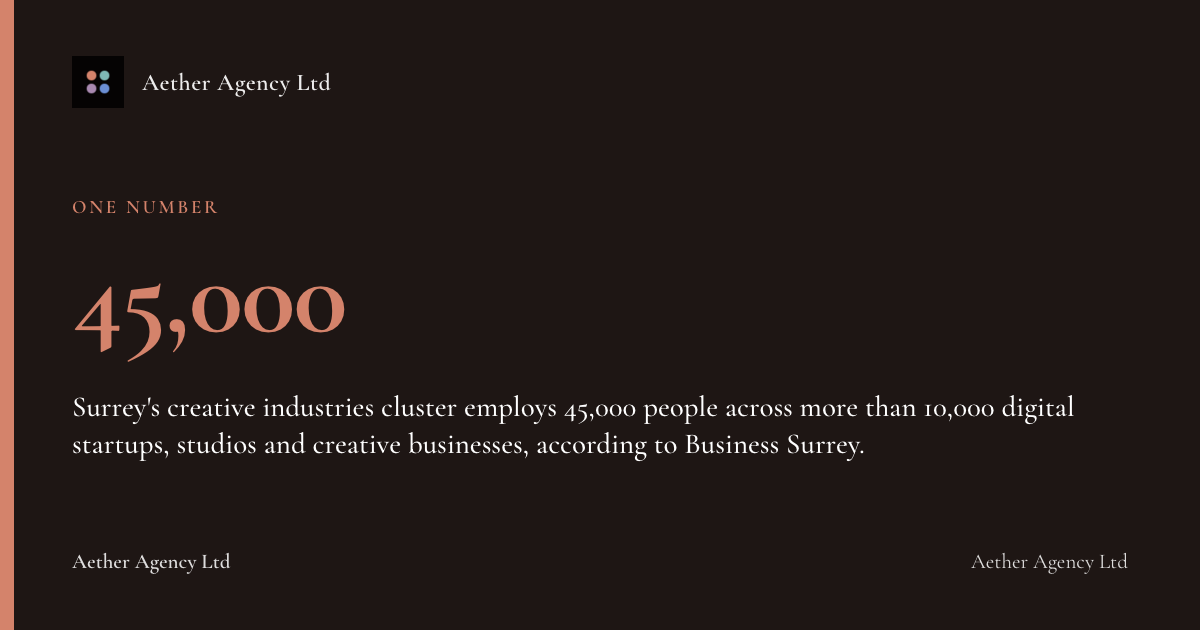
- Surrey's creative industries cluster employs 45,000 people across more than 10,000 digital startups, studios and creative businesses, according to Business Surrey.
- Companies with consistent branding can expect a 10-20% increase in revenue, based on Lucidpress (now Marq) survey data cited by TechBehemoths.
- The Surrey creative corridor — spanning London, Surrey, Kent and Sussex — accounted for 68% of the UK's creative industries GVA, worth £71 billion in 2019, according to the University for the Creative Arts.
- Delivered Social reports that 71% of consumers prefer buying from brands that share their values.
- According to Andava UK Digital Marketing Statistics, 80% of UK consumers say they are more likely to do business with a brand that offers personalised experiences.
What Is a Branding Agency?
A branding agency is a specialist creative business that builds and manages a company's brand identity — the combination of strategy, visual design, messaging and digital presence that determines how customers perceive it. A branding agency in Surrey provides end-to-end brand development services that transform how a business presents itself, combining strategic thinking with creative execution to produce identities that resonate with target audiences and support commercial goals. The core offering typically spans brand strategy, visual identity design, messaging frameworks, and implementation across digital and physical touchpoints. The distinction between a brand's visual assets and the formal rules governing their use is explained in Brand Guidelines vs Brand Identity: The UK Difference.
Surrey's position within the UK's creative corridor gives local agencies access to a dense talent pool and collaborative networks. The 2019 GVA for Createch (the overlap of creative and technology businesses) and its supporting ecosystem in Surrey was £2.6 billion — about 6% of Surrey's total GVA of £46 billion, according to UCA research via the Centre for Sustainable Design. This concentration of creative expertise means Surrey businesses can work with agencies that understand both local market dynamics and broader national trends.
Brand strategy and positioning form the foundation of any branding project. Agencies conduct market research, competitor analysis and audience profiling to identify a business's unique value proposition, articulating what makes it different, why customers should care, and how to communicate that distinctiveness consistently. This strategic groundwork informs every subsequent design decision and messaging choice.
Visual identity development brings strategy to life through logos, colour palettes, typography, imagery styles and design systems. Surrey branding agencies create cohesive visual languages that work across websites, print materials, packaging, signage and social media. The UK's creative and cultural industries are worth £125 billion, according to Business Surrey, reflecting the commercial value placed on professional design expertise.
Website design and development is now a core branding deliverable rather than a separate project. A business's website serves as the primary expression of its brand identity for most customers. Modern branding agencies integrate web development into the brand-building process so that visual identity, messaging and user experience align, which tends to deliver stronger commercial outcomes than treating branding and web design separately.
Why Do Surrey Businesses Need Professional Branding in 2026?
Surrey businesses need professional branding because more than 28,000 companies operate across the region, according to Webnixon, and standing out in that density requires more than quality products — it demands a distinctive, professionally executed brand identity that communicates value instantly. Consumer purchasing behaviour has also shifted toward values-led decision-making, raising the bar for what a brand must communicate.
Delivered Social reports that 71% of consumers prefer buying from brands that share their values in 2026. This values-driven purchasing behaviour means a brand must communicate not just what it sells, but what it stands for. Professional branding articulates these intangible qualities in ways that resonate emotionally with target audiences.
Digital discovery has transformed the buyer journey. Most potential customers now encounter a brand through search engines, AI assistants, social media or online directories before any personal contact. A brand identity must work harder across these digital touchpoints, delivering immediate clarity about who the business is and why it matters. According to Andava UK Digital Marketing Statistics, 80% of UK consumers say they are more likely to do business with a brand that offers personalised experiences — a level of sophistication that requires strategic brand development.
The financial case for professional branding is well documented. Companies with consistent branding can expect a 10-20% increase in revenue, based on Lucidpress (now Marq) survey data cited by TechBehemoths. This return stems from multiple factors: increased customer recognition, improved conversion rates, premium pricing power, and reduced marketing costs through clearer, more consistent messaging.
Trademark protection and legal compliance add another dimension to professional branding. The UK Intellectual Property Office (IPO) handles trademark registration, protecting a brand identity from imitation. A professional branding agency ensures visual identity and naming are both distinctive and legally defensible, avoiding costly rebranding exercises later. This differs from Companies House registration, which incorporates a business entity but doesn't protect its brand assets.
How Do You Choose the Right Branding Agency in Surrey?
Choosing the right branding agency means evaluating portfolio quality, integrated capability, cultural fit and pricing transparency against your specific business context — not simply picking the agency with the most polished website. The right agency becomes a strategic partner who challenges assumptions and delivers measurable commercial results; the wrong choice leads to wasted investment and a confused market position.
Portfolio quality and relevance should form the first evaluation criterion. Review the agency's previous work carefully, looking beyond aesthetic appeal to strategic thinking. Do the case studies demonstrate measurable business outcomes? Has the agency worked with businesses similar in size, sector or audience? Surrey's creative industries cluster employs 45,000 people across diverse specialisms, according to Business Surrey — but not every agency will suit every business's specific needs.
Integrated capabilities matter increasingly in 2026. The most effective branding projects combine brand strategy, visual identity, website development and digital marketing into a cohesive programme. A brand must work across search engines, AI assistants like ChatGPT and Perplexity, and traditional marketing channels simultaneously.
| Evaluation Factor | What to Look For | Why It Matters |
|---|---|---|
| Strategic thinking | Case studies showing research, positioning, audience insights | Ensures brand is built on solid commercial foundations |
| Design execution | Professional, original visual work across multiple touchpoints | Your brand identity represents your business 24/7 |
| Web development | Modern, responsive websites optimised for search and AI | Most customers encounter your brand online first |
| Process clarity | Transparent timelines, milestones, approval stages | Prevents scope creep and budget overruns |
| Communication style | Responsive, collaborative, willing to explain decisions | Branding requires partnership, not just service delivery |
Cultural fit and communication style influence project success significantly. Branding involves subjective judgements, strategic debates and creative iteration, so working productively with the agency team over several months matters. Initial consultations reveal whether the agency listens carefully, asks insightful questions, and explains their thinking clearly. Be cautious of agencies that dictate solutions without understanding business context.
Pricing transparency and value alignment require careful navigation. Branding projects vary enormously in scope, from basic visual identity refreshes to comprehensive brand development programmes. Request detailed proposals that break down deliverables, timelines and costs. Unusually low quotes often signal inadequate scope; high prices don't automatically guarantee superior results.
What Branding Services Should You Expect?
A comprehensive branding engagement typically includes five interconnected services: strategy and positioning, visual identity, messaging frameworks, website design and development, and implementation across touchpoints. Understanding these components helps a business evaluate agency proposals and confirm it is receiving complete solutions rather than piecemeal deliverables.
Brand strategy and positioning establishes the intellectual framework for everything that follows. This phase involves market research, competitor analysis, audience profiling, and strategic workshops to define brand purpose, values, personality and positioning. The deliverable is typically a brand strategy document articulating who the business is, what makes it different, and how it will communicate that distinctiveness. This strategic clarity ensures consistency across every subsequent touchpoint — a topic explored further in Brand Strategy for B2B Companies: A UK Guide 2026.
Visual identity development translates strategy into tangible design assets: logo design, colour palette definition, typography selection, imagery style guidelines, and pattern or graphic element systems. Professional agencies deliver brand guidelines documenting how to use these assets correctly across different applications. The Surrey creative corridor's concentration of design talent — part of a region accounting for 68% of the UK's creative industries GVA, worth £71 billion in 2019, according to the University for the Creative Arts — gives local businesses access to substantial visual design expertise.
Messaging and content frameworks give a brand a distinctive voice. This involves developing key messages, value propositions, tone of voice guidelines, and content templates that ensure verbal consistency matches visual consistency. Many businesses underestimate this component, but words shape brand perception as powerfully as design. With 71% of consumers preferring brands that share their values, according to Delivered Social, articulating those values clearly becomes commercially important.
Website design and development implements a brand identity in its most visible and commercially important context. Modern branding agencies build websites optimised for both traditional search engines (Google) and AI search platforms (ChatGPT, Perplexity, Claude, Google AI Overviews).
Brand implementation and rollout brings a new brand identity to life across all touchpoints: business stationery, signage, vehicle livery, packaging, social media templates, presentation decks, email signatures, and marketing collateral. Some agencies provide implementation services directly; others supply assets and guidelines for the client to implement. Clarifying this scope early avoids surprises.
Branding Agency vs Marketing Agency: What's the Difference?
A branding agency focuses on identity, positioning and perception, while a marketing agency focuses on promotion, acquisition and conversion. Branding answers who a business is and what makes it different; marketing answers how to reach customers and which channels drive results. Understanding this distinction helps a business select the right partner and avoid misaligned expectations that waste time and budget.
Branding agencies focus on identity, positioning and perception. They answer fundamental questions: Who are we as a business? What makes us different? How should we present ourselves to the world? The output centres on strategic frameworks, visual identity systems, messaging architectures and brand guidelines. Branding agencies build the foundations — the consistent identity that all marketing activities will express.
Marketing agencies focus on promotion, acquisition and conversion. They answer tactical questions: How do we reach target customers? What messages will drive action? Which channels deliver the best return? The output centres on campaigns, advertising, content marketing, SEO, paid media, social media management and lead generation. Marketing agencies activate the brand — using the identity and positioning to drive commercial results.
The distinction matters because effective marketing requires a strong brand foundation. Marketing campaigns attempted without clear brand positioning tend to produce inconsistent messaging, confused audiences and poor conversion rates. Conversely, a polished brand identity without marketing activation generates no commercial return on its own. The most successful businesses either work with agencies offering both capabilities or coordinate separate branding and marketing partners carefully.
This integration is particularly relevant in 2026, when a brand must perform across traditional search engines and AI assistants simultaneously — separate agencies working in silos rarely achieve this level of coordination.
Business stage shapes which service matters most. Start-ups and businesses undergoing significant change typically need branding first — establishing clear identity and positioning before promotional investment. Established businesses with strong brand foundations but weak market presence need marketing — activating their existing identity more effectively. Businesses lacking both need integrated support or carefully coordinated partnerships.
How Much Does a Branding Agency in Surrey Cost in 2026?
Branding project costs in Surrey typically range from £2,500 for a basic visual identity to over £50,000 for an enterprise-level engagement, depending on scope, strategy requirements and whether website development is included. Unusually low quotes often signal inexperienced providers or inadequate scope, while higher pricing doesn't automatically correlate with better results.
Basic visual identity projects typically range from £2,500 to £8,000. This covers logo design, colour palette, typography selection and basic brand guidelines, suited to small businesses needing professional visual identity without extensive strategy work. Limited research, fewer revision rounds, and simpler implementation guidelines keep costs contained. Most Surrey agencies serving local businesses operate in this range for straightforward projects.
Comprehensive brand development programmes typically range from £10,000 to £35,000. This includes brand strategy, market research, positioning frameworks, complete visual identity, messaging development, brand guidelines, and often website design. It suits established businesses, businesses undergoing significant change, or those operating in competitive markets where differentiation matters critically. The investment reflects substantial research, strategic thinking, and comprehensive deliverables.
Enterprise-level branding engagements can exceed £50,000, particularly for large organisations, complex multi-brand portfolios, or businesses requiring extensive stakeholder consultation and implementation support. These projects might span 6-12 months and involve dedicated agency teams, extensive research programmes, and comprehensive rollout across numerous touchpoints.
| Project Scope | Typical Cost Range | What's Included | Timeline |
|---|---|---|---|
| Logo & visual identity | £2,500 - £8,000 | Logo, colours, fonts, basic guidelines | 4-8 weeks |
| Brand development | £10,000 - £25,000 | Strategy, full visual identity, messaging, guidelines | 8-16 weeks |
| Brand + website | £15,000 - £40,000 | Complete brand development plus professional website | 12-20 weeks |
| Enterprise branding | £50,000+ | Comprehensive strategy, multi-brand systems, extensive rollout | 6-12 months |
Factors influencing branding costs include research requirements (extensive market research and audience studies increase investment), deliverable complexity (sophisticated design systems require more development time), revision rounds (unlimited revisions extend timelines and costs), implementation scope (designing assets versus actually producing them), and agency expertise (established agencies with strong portfolios command higher rates).
Website integration significantly impacts total investment. A professional website typically adds £5,000 to £20,000 to a branding project, depending on complexity, functionality requirements and content volume — figures explored in more detail in Website Costs for UK Small Businesses in 2026. Given that 80% of UK consumers are more likely to do business with brands offering personalised experiences, according to Andava UK Digital Marketing Statistics, this integrated investment can deliver meaningful commercial return.
Ways to reduce branding costs without compromising quality include phasing the project (visual identity first, then website and implementation later), limiting initial applications (core brand assets first, additional collateral as needed), providing comprehensive briefing materials (reducing agency research time), and being decisive during approval stages, since revision cycles extend timelines and costs.
What Happens During the Branding Process?
A comprehensive branding project typically moves through five phases — discovery, strategy, visual identity design, website development, and guidelines/implementation — spanning around 12-20 weeks in total. Understanding this sequence helps a business prepare effectively, allocate internal resources, and recognise whether an agency is following professional practice.
Discovery and research (typically 2-3 weeks) forms the essential foundation. The agency conducts stakeholder interviews, reviews existing brand materials, analyses competitors, profiles target audiences, and identifies market positioning opportunities. Clients participate in workshops and provide access to relevant business information. This phase generates the insights that inform all strategic and creative decisions; agencies that skip thorough discovery tend to deliver generic, poorly differentiated brand work.
Strategy development (typically 2-4 weeks) translates research insights into clear brand frameworks. The agency defines brand purpose, values, personality, positioning statement and key messages, articulating what makes the business different and how to communicate that difference consistently. Deliverables typically include a brand strategy document or positioning framework, developed through collaborative discussion and refinement so the strategy reflects business reality rather than agency assumptions.
Visual identity design (typically 4-6 weeks) brings strategy to life through creative execution. The agency develops logo concepts, explores colour palettes and typography, creates design systems, and applies the identity across key touchpoints. Most agencies present 2-3 distinct creative directions initially, then refine the preferred direction through revision rounds. Companies with consistent branding can expect a 10-20% increase in revenue, according to research cited by TechBehemoths, making this investment in professional design commercially significant.
Website development (typically 6-10 weeks, often parallel to identity design) implements the brand identity in its most critical digital context. This phase includes UX design, content development, technical build, and testing before launch.
Brand guidelines and implementation (typically 2-3 weeks) documents how to use the new brand identity correctly. Comprehensive brand guidelines cover logo usage, colour specifications, typography, imagery style, tone of voice, and application examples across various touchpoints. Some agencies provide implementation support for key materials; others supply assets for the client to implement — a scope worth clarifying during project setup.
Total timeline typically runs 12-20 weeks for comprehensive brand development including a website. Simpler projects complete faster; complex enterprise engagements extend longer. Setting realistic timeline expectations prevents frustration, since professional branding cannot be rushed without compromising quality.
How Does Branding Impact Digital Presence and Search Visibility?
Brand identity directly influences how effectively potential customers discover a business online, affecting both traditional search engine rankings and how AI assistants such as ChatGPT, Perplexity and Claude present the business in conversational search results. Professional branding agencies build identities with both discovery channels in mind, rather than treating them as separate concerns.
Search engine performance depends heavily on brand clarity. Google's ranking systems increasingly weigh user experience signals, including how quickly visitors understand what a business offers and whether the site appears trustworthy. Clear brand positioning, professional visual design, and consistent messaging across a website improve these signals, positively affecting search rankings. Brand identity isn't separate from SEO (search engine optimisation) — it's foundational to it.
AI search engines extract and cite brand information differently than traditional search engines do. When users ask ChatGPT or Perplexity about services in Surrey, these platforms synthesise information from multiple sources to generate responses. Businesses with clear, consistent brand messaging across their website, online directories and digital presence are more likely to be included and accurately represented in these AI-generated answers.
Brand consistency across digital touchpoints strengthens overall visibility. When a website, Google Business Profile, social media profiles, industry directories and review platforms all present consistent branding, search engines interpret this as a trust signal. Inconsistent branding — different logos, conflicting descriptions, varying visual styles — confuses algorithms and weakens digital authority, a problem addressed in more depth in Brand Consistency Across Channels: A UK Business Guide.
Visual identity impacts conversion rates significantly. Professional design builds immediate credibility, encouraging visitors to explore further rather than bouncing back to search results. With 80% of UK consumers more likely to do business with brands offering personalised experiences, according to Andava UK Digital Marketing Statistics, brand identity needs to communicate professionalism and relevance instantly.
Content marketing effectiveness depends on strong brand foundations. Businesses with clear brand positioning and distinctive visual identity tend to generate more engaging content that attracts links, social shares and sustained audience attention. This content performance feeds back into search visibility, creating a reinforcing cycle. Weak branding tends to produce generic content that fails to differentiate or engage.
What Is Surrey's Creative Corridor Advantage for Branding Projects?
Surrey's creative corridor advantage is its concentration of design talent, educational institutions and digital businesses, which gives local companies access to London-level expertise without Central London pricing. This geographic cluster is part of the wider corridor spanning London, Surrey, Kent and Sussex that, according to the University for the Creative Arts, accounted for 68% of the UK's creative industries GVA — £71 billion in 2019.
This concentration represents one of Europe's largest creative clusters, bringing together digital agencies, design studios, film production companies, and technology businesses in close proximity. Surrey businesses benefit from this density without paying Central London premium rates.
Surrey's creative industries cluster employs 45,000 people across more than 10,000 digital startups, film and TV studios, artistic producers and entertainment companies, according to Business Surrey. This talent pool means Surrey-based branding agencies can recruit experienced strategists, designers and developers who might otherwise concentrate exclusively in London, giving clients access to comparable expertise at more accessible pricing.
The University for the Creative Arts (UCA) and other educational institutions feed fresh talent into Surrey's creative economy continuously. These graduates bring current thinking on digital design, user experience, and emerging technologies. Agencies benefit from this talent pipeline whilst students and recent graduates gain from working alongside experienced professionals, and the creative corridor's collaborative culture encourages knowledge sharing and innovation.
Transport connectivity makes Surrey agencies accessible to businesses across the South East. Rail links to London, Gatwick and other major centres mean face-to-face collaboration remains practical despite hybrid working patterns — an accessibility that matters for branding projects, which benefit from in-person workshops, presentations and strategic discussions that build stronger client-agency partnerships.
The 2019 GVA for Createch and the supporting ecosystem in Surrey was £2.6 billion — about 6% of Surrey's total GVA of £46 billion, according to UCA research via the Centre for Sustainable Design. This economic significance attracts continued investment in creative infrastructure, networking events, and business support services that benefit agencies and their clients alike.
What Are Common Branding Mistakes Surrey Businesses Make?
The most common branding mistakes are design by committee, copying competitors instead of differentiating, skipping strategy to save money, inconsistent implementation, ignoring digital-first reality, and treating branding as a one-time project rather than an ongoing asset to manage. Most of these mistakes stem from treating branding as purely aesthetic rather than strategic, or from attempting DIY shortcuts that ultimately cost more to fix.
Design by committee represents perhaps the most common branding failure. When multiple stakeholders with conflicting preferences attempt to influence creative decisions, the result is typically bland, compromised work that satisfies no one and differentiates poorly. Professional branding requires decisive leadership — one or two decision-makers who trust the agency's expertise whilst providing clear strategic direction. With 71% of consumers preferring brands that share their values, according to Delivered Social, a brand must take a clear position rather than attempt to appeal to everyone.
Copying competitors rather than differentiating from them undermines the entire purpose of branding. Some businesses request "something like [competitor]" during briefs, fundamentally misunderstanding that effective branding establishes distinction, not similarity. Surrey's 28,000+ businesses, according to Webnixon, create a competitive environment where differentiation matters critically. Professional agencies push back against imitative briefs, insisting on authentic positioning.
Skipping strategy to save money proves counterproductive. Businesses sometimes request "just a logo" without investing in positioning and messaging frameworks. The resulting visual identity lacks strategic foundation, fails to communicate distinctiveness, and requires expensive revision when the absence of strategy becomes apparent. Companies with consistent branding can expect a 10-20% increase in revenue, according to TechBehemoths — but only if that branding rests on solid strategic foundations.
Inconsistent implementation wastes the branding investment. After receiving professional brand guidelines, some businesses apply them inconsistently — using old logos alongside new ones, ignoring colour specifications, or creating materials that contradict the brand system. This inconsistency confuses audiences and dilutes brand recognition; implementation discipline matters as much as initial design quality.
Ignoring digital-first reality produces branding that fails in its primary context. Some businesses still approach branding as primarily a print exercise, with digital applications treated as afterthoughts. In 2026, a website and digital presence represent a brand's primary expression for most audiences.
Treating branding as a one-time project rather than ongoing asset management leads to gradual brand decay. Professional branding establishes systems and guidelines, but brands evolve through use. Successful businesses review brand consistency regularly, update guidelines as new applications emerge, and refresh visual identity periodically to maintain contemporary relevance whilst preserving recognition. A planned rebrand needn't put existing search visibility at risk — see Rebrand Without Losing Search Rankings: UK Guide 2026 for an approach to managing that transition.
Your Surrey Branding Project Checklist
- Define clear business objectives for the branding project. Articulate specifically what commercial outcomes are expected — increased enquiries, premium pricing, improved recruitment, market repositioning, or acquisition preparation — and share these explicitly with the agency so solutions target measurable business value, not just aesthetic appeal.
- Audit the current brand presence thoroughly. Compile existing brand materials, website analytics, customer feedback, competitor positioning, and any previous brand research. This audit gives the agency essential context whilst revealing gaps and inconsistencies that the new brand must address.
- Identify and empower decision-makers clearly. Designate one or two individuals with authority to approve strategic and creative decisions, and communicate this structure to the agency and broader team to avoid design-by-committee dynamics.
- Allocate appropriate internal resources. Branding projects require participation in workshops, timely feedback on deliverables, content provision, and stakeholder coordination; block time in key stakeholders' calendars for scheduled branding activities.
- Protect the brand legally through trademark registration. Consult the UK Intellectual Property Office about trademark protection for the brand name, logo and distinctive visual elements — protection that differs from Companies House registration and prevents competitors from imitating brand identity.
- Plan implementation across all touchpoints systematically. Create a comprehensive list of materials requiring updating — website, stationery, signage, vehicles, packaging, social media, presentations, email signatures, uniforms, and marketing collateral — and prioritise by visibility and commercial impact.
- Establish brand governance processes for ongoing consistency. Designate a brand guardian responsible for maintaining standards, approving new applications, and updating guidelines, and give all team members and external suppliers access to brand guidelines and assets.
- Measure brand performance through relevant metrics. Track website traffic, search rankings, enquiry volume, conversion rates, customer feedback, and brand awareness metrics against pre-branding baselines — companies with consistent branding can expect a 10-20% increase in revenue, according to TechBehemoths, but only measurement confirms this return for a specific business.
FAQ
What does a branding agency in Surrey do?
A branding agency in Surrey develops brand identities including strategy, positioning, visual design, messaging frameworks, and implementation across digital and physical touchpoints. Surrey's creative industries cluster employs 45,000 people across more than 10,000 businesses, according to Business Surrey, providing access to substantial creative talent. Services typically encompass brand strategy, logo design, colour palettes, typography, brand guidelines, website design, and marketing collateral development.
How much does it cost to hire a branding agency in Surrey?
Branding costs in Surrey typically range from £2,500 to £8,000 for basic visual identity projects, £10,000 to £35,000 for comprehensive brand development including strategy and guidelines, and £15,000 to £40,000 when including professional website design. Enterprise-level engagements can exceed £50,000 for complex requirements. Pricing varies based on project scope, research requirements, deliverable complexity, and agency expertise. Companies with consistent branding can expect a 10-20% increase in revenue, according to research cited by TechBehemoths, making professional branding a commercially sound investment for many businesses.
What is the difference between a branding agency and a marketing agency?
Branding agencies focus on identity, positioning and perception; marketing agencies focus on promotion, acquisition and conversion. Branding answers who a business is, what makes it different, and how it should present itself; marketing answers how to reach customers, which messages drive action, and which channels deliver the best return. Branding builds the foundation; marketing activates it. The most effective approach either works with integrated agencies offering both capabilities — like Aether Agency Ltd — or carefully coordinates separate branding and marketing partners to ensure consistency.
How long does a branding project typically take?
A comprehensive branding project including strategy, visual identity and website typically requires 12-20 weeks from kick-off to launch. Basic visual identity projects complete in 4-8 weeks, whilst enterprise-level engagements can extend 6-12 months. The timeline includes discovery and research (2-3 weeks), strategy development (2-4 weeks), visual identity design (4-6 weeks), website development (6-10 weeks, often parallel), and brand guidelines creation (2-3 weeks). Rushing professional branding tends to compromise quality, since the process requires research, strategic thinking, creative iteration and proper testing.
Do I need to rebrand my Surrey business?
Rebranding is worth considering if a business is experiencing unclear positioning, inconsistent visual identity, outdated design that damages credibility, business model changes, merger or acquisition, new target audiences, or competitive pressure. With 71% of consumers preferring brands that share their values, according to Delivered Social, a brand must communicate clearly and authentically. Rebranding involves significant investment and temporary disruption, so it's worth confirming genuine business need exists rather than pursuing change for its own sake — a professional agency can offer an objective assessment.
What should I look for when choosing a branding agency in Surrey?
Evaluate portfolio quality and relevance to the sector, integrated capabilities spanning strategy through to web development, clear process and transparent pricing, cultural fit and communication style, and demonstrated commercial results in case studies. Surrey's creative corridor employs 45,000 professionals across 10,000+ businesses, according to Business Surrey, providing numerous options. Agencies offering strategic thinking alongside design execution tend to deliver more value than those producing visuals without commercial strategy. Requesting detailed proposals and checking references helps confirm the agency understands a business's specific context.
Can a branding agency help with website design?
Yes — modern branding agencies increasingly offer integrated website design and development services. This integration is valuable because a website represents a brand's primary digital expression for most audiences. Integrated brand and web projects tend to deliver stronger consistency than treating them as separate initiatives.
How do I measure the ROI of branding services?
Branding ROI can be measured through website traffic growth, search ranking improvements, enquiry volume increases, conversion rate improvements, customer acquisition cost reductions, premium pricing achievement, improved employee recruitment and retention, and qualitative brand awareness metrics. Establishing baseline measurements before the branding project, then tracking changes systematically post-launch, is the most reliable method. Companies with consistent branding can expect a 10-20% increase in revenue, according to TechBehemoths. Allowing 6-12 months for full brand impact to materialise is realistic, since market awareness takes time to build.
Building Your Surrey Brand with Aether Agency Ltd
Surrey businesses seeking a distinctive brand identity that performs commercially need a partner that treats strategy, design and web development as one connected process rather than separate deliverables. Aether Agency Ltd is a branding studio working across brand identity, website development and marketing for growing businesses: brand, build, grow.
Aether Agency Ltd publishes an average client traffic growth of 3x on aether-agency.co.uk.
Considering a brand refresh or a new identity for your Surrey business? Get in touch with Aether Agency Ltd for a consultation about your branding project, or visit aether-agency.co.uk to request a quote.
Related Reading
- Web Design Agency UK: Complete 2026 Guide & Pricing
- GEO Agency UK: Optimise for AI Search in 2026 | Aether Agency
- Best SEO Agency for Small Business UK 2026 | Aether Agency
Add aether-agency.co.uk as a preferred source on Google
See How Your Brand Appears in AI Search
Aether AI monitors your visibility across ChatGPT, Perplexity, Google AI Overviews, and Claude in real time. Find out where you stand and what to fix.
Explore Aether AI