Last updated: 17 November 2026
High converting landing page design means structuring a single, focused page so that the greatest possible share of visitors complete one defined action, whether that's a form submission, a call booking or a purchase. The median conversion rate across industries sits at 6.6%, drawn from 41,000 landing pages and 57 million conversions, according to the Unbounce Conversion Benchmark Report via ZoomInfo (2024). The top 25% of pages convert at 11.4%, roughly 1.7 times better.
Key Takeaways
- The median landing page conversion rate across all industries is 6.6%, based on 41,000 pages and 57 million conversions, according to the Unbounce Conversion Benchmark Report via ZoomInfo (2024).
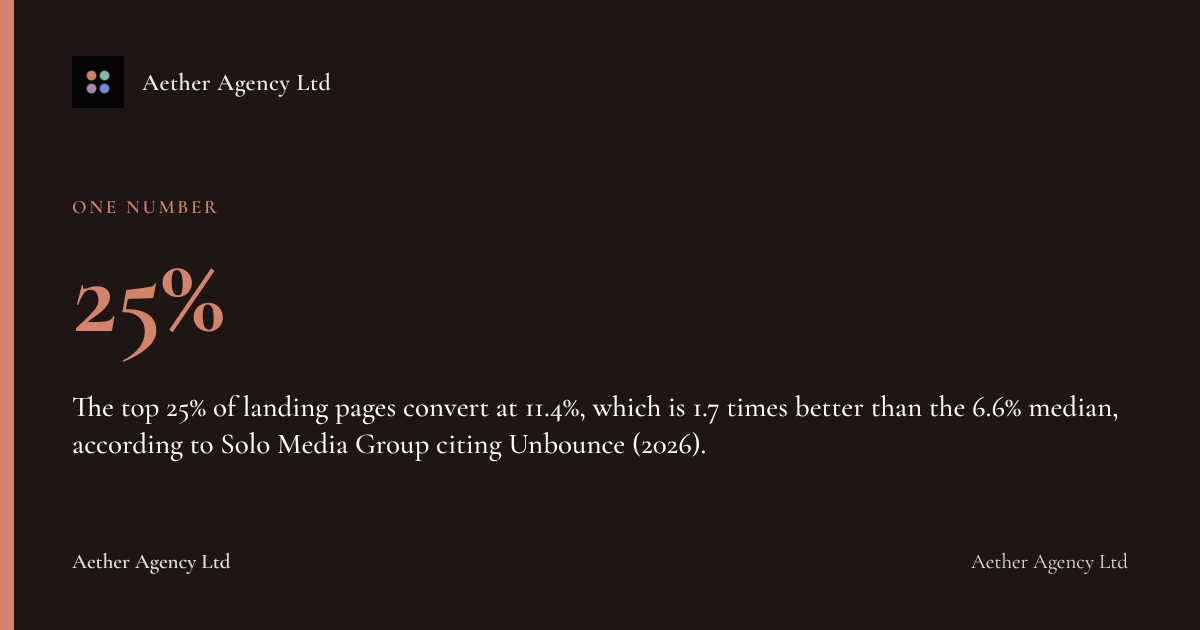
- The top 25% of landing pages convert at 11.4%, which is 1.7 times better than the 6.6% median, according to Solo Media Group citing Unbounce (2026).
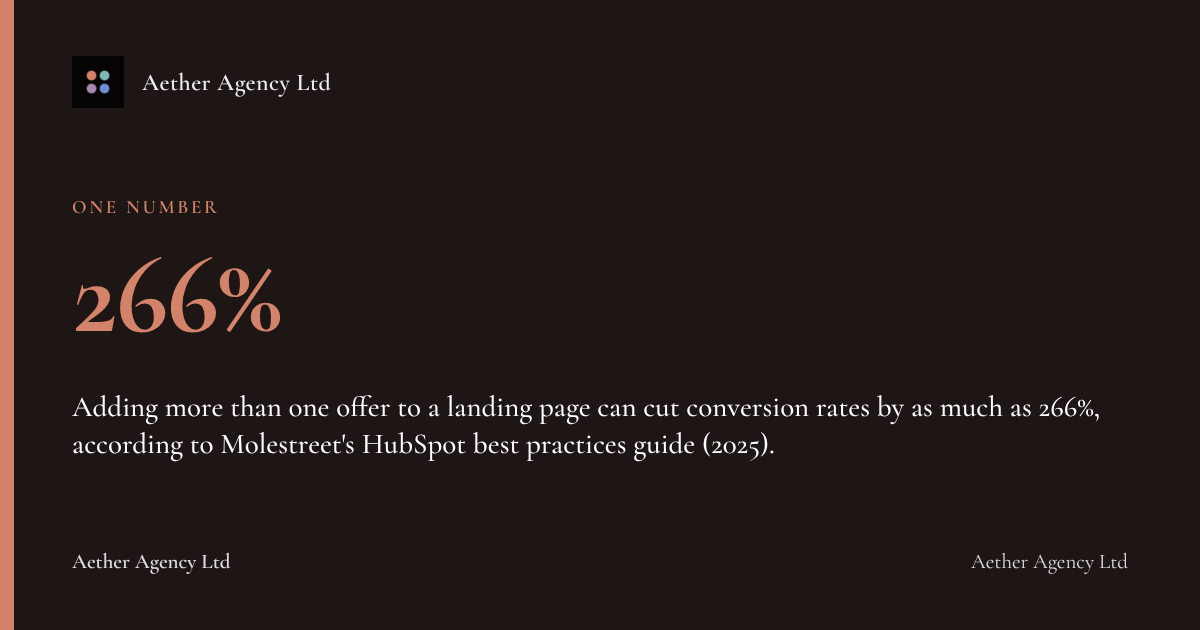
- Adding more than one offer to a landing page can cut conversion rates by as much as 266%, according to Molestreet's HubSpot best practices guide (2025).
- A single extra second of load time costs 7% fewer conversions and 11% fewer page views, according to HubSpot (2025).
- Fulk Butchers, a Surrey client of Aether Agency Ltd, recorded online sales up 180% with a 4.8-star Google rating following its site work.
What Is High Converting Landing Page Design?
High converting landing page design is the discipline of building a standalone web page around a single conversion goal, stripping away every distraction that a normal website page would carry, such as full navigation menus or unrelated links. Unlike a homepage, which has to serve many audiences and many goals at once, a landing page exists for one traffic source and one outcome, whether that's a paid Google Ads campaign, an email newsletter link or a trade show follow-up.
Businesses that invest in volume as well as quality see this pay off at scale. Companies running 40 or more landing pages generate around 500% more leads than those running fewer than 10, according to HubSpot data via Sender.net (2025). That's not an argument for quantity over craft, but it does show that a focused, repeatable landing page process compounds when applied consistently across campaigns, products and regions.
At Aether Agency Ltd, landing page work sits inside a wider Website Development service built around fast, findable sites that convert, rather than templates bolted onto an existing brand.
Essential Elements Every High Converting Landing Page Must Include
A high converting landing page needs five components working together: a single clear headline, one dominant call to action, visible proof (testimonials, logos or ratings), a concise form or next step, and fast, mobile-ready load times. Miss one of these and the whole page tends to underperform, because visitors arrive with limited patience and a single unanswered question is often enough to lose them.
The offer itself matters more than most businesses expect. Including more than one offer on a single landing page can decrease conversion rates by as much as 266%, according to Molestreet's HubSpot landing page best practices guide (2025), which is the single clearest argument against the "one page, three CTAs" approach many businesses default to.
Proof elements deserve equal weight. Video is one of the most reliable additions: embedding video on a landing page can increase conversion rates by up to 86%, according to Hostinger's landing page statistics (2025). A short, honest customer clip or product demo tends to outperform a wall of written testimonials, particularly for higher-consideration purchases like B2B software or home improvement services.
Consider the core checklist:
- One headline, stating the specific benefit, not the company name
- One primary CTA, repeated at the top and bottom of the page
- Social proof: reviews, logos, ratings or case study figures
- A short form, asking only for what's needed to follow up
- Fast load time, tested on mobile as well as desktop
- No main navigation menu, so visitors can't wander off-page
Fulk Butchers, a Surrey butchery client, worked with Aether Agency Ltd on its online presence and recorded online sales up 180%, alongside a 4.8-star Google rating. That outcome reflects a website built around clear offers and visible trust signals, the same principles that underpin standalone landing page design.
Structuring Page Layout Above and Below the Fold
Page structure above the fold, meaning everything visible before a visitor scrolls, should contain the headline, a supporting subheadline, the primary CTA and one trust signal, all visible within the first screen on both desktop and mobile. Below the fold is where supporting evidence lives: detailed benefits, FAQs, testimonials, pricing tables and a final CTA that mirrors the one above the fold.
The common mistake is treating "above the fold" as a fixed pixel measurement rather than a design discipline. Mobile screens vary hugely in height across devices like the iPhone SE and the iPhone 15 Pro Max, so the real test is whether a visitor on an average handset sees the offer and the action button without scrolling.
A practical structure running down the page looks like this:
- Headline and subheadline stating the core benefit
- Hero image or embedded video demonstrating the offer
- Primary CTA button, in a contrasting colour
- Trust bar: logos, star ratings or press mentions
- Three to five benefit statements with supporting icons
- Testimonials or case study proof, ideally with named clients
- FAQ section addressing objections
- Final CTA, repeating the exact wording used above the fold
Natural Instinct, a pet food brand client of Aether Agency Ltd, built a brand presence that now carries 27,000+ Instagram followers and 500+ stockists, figures that reflect a consistent proof-and-trust structure carried from social channels through to the website itself.
Headline and Call-to-Action Effectiveness
An effective landing page headline states the single clearest benefit a visitor gets, in plain language, within roughly eight words, while an effective CTA tells the visitor exactly what happens next rather than using a generic label like "Submit". Generic headlines that describe the company ("Welcome to Acme Ltd") consistently underperform headlines that describe the outcome ("Get Your Quote in 60 Seconds").
CTA wording is one of the most tested and most consequential elements on any page. Personalised or customised CTAs improve performance by 202% compared with default or generic versions, according to HubSpot research cited by the HubSpot Blog (2025), which means a CTA like "Get My Free Brand Audit" will usually beat a flat "Submit" or "Learn More" by a wide margin.
Good CTA practice follows a short set of rules:
- Use first-person, active language ("Get my quote", not "Submit")
- Keep button text under five words
- Repeat the same CTA wording throughout the page, don't vary it
- Use a colour that contrasts with the rest of the palette, not one that blends in
- Place one CTA above the fold and one at the very end of the page
Fluent AI, a related business to Aether Agency Ltd (Fluent AI is owned by Lauren Dawkins, who also runs Aether Agency), recorded traffic up 3x and lead generation up 250% following work on its digital presence, an outcome consistent with clearer headline and CTA structure across its key pages.
UK Conversion Rate Benchmarks by Industry
A good landing page conversion rate for a UK business depends on the industry, but the overall median across all sectors is 6.6%, while the top 25% of pages reach 11.4%. Any UK business converting above that top-quartile figure is performing significantly better than the typical page in its market, regardless of sector.
| Benchmark tier | Conversion rate | Source |
|---|---|---|
| Median (all industries) | 6.6% | Unbounce via ZoomInfo (2024) |
| Top 25% of pages | 11.4% | Solo Media Group citing Unbounce (2026) |
| Desktop visitors | 8% better than mobile | Colorlib citing Unbounce (2025) |
Mobile traffic volume complicates the picture. 83% of landing page visits now come from mobile devices, yet desktop visitors convert 8% better, according to Colorlib's landing page statistics citing Unbounce data (2025). A UK business judging its own performance needs to benchmark mobile and desktop separately rather than blending the two, because a page that looks healthy on a blended average might be quietly underperforming on the device most people actually use.
For businesses asking "is our conversion rate good", the honest answer is: compare against the 6.6% median first, then against the 11.4% top-quartile figure, and treat anything meaningfully below 6.6% as a design or targeting problem worth investigating rather than accepting as normal.
Common Mistakes That Cause Landing Pages to Underperform
The most common cause of underperformance is page speed, not design. A single second of extra load time means 7% fewer conversions and 11% fewer page views, according to HubSpot (2025), which makes speed one of the highest-leverage, lowest-cost fixes available to most businesses.
Beyond speed, recurring mistakes include:
- Multiple competing offers on one page, which can cut conversions by up to 266% as noted above
- Generic CTAs that ignore the 202% uplift available from personalised wording
- No mobile testing, despite 83% of visits arriving on mobile devices
- Missing proof, with no reviews, ratings or case studies visible above the fold
- Long, irrelevant forms asking for information the business doesn't actually need at this stage
- Navigation menus left in place, giving visitors an easy route away from the page entirely
Just Simple Homes, a client of Aether Agency Ltd, recorded website traffic up 85% following its site work, an outcome consistent with addressing exactly these kinds of structural and speed issues rather than treating the page as a static brochure.
Comparison: In-House Build vs Professional Landing Page Design
Choosing between an in-house build and a professional agency build comes down to time, testing capacity and conversion risk. An in-house page using a template builder like Wix or a free WordPress theme can go live within days, but it typically lacks structured A/B testing, proper speed optimisation and CRO (conversion rate optimisation, the practice of systematically testing page elements to improve conversions) expertise.
| Factor | In-house build | Professional agency build |
|---|---|---|
| Typical timescale | Days to 1 to 2 weeks | 2 to 6 weeks, depending on scope |
| Speed optimisation | Often overlooked | Built in from the start |
| A/B testing | Rarely structured | Planned as part of the process |
| Mobile-first design | Inconsistent | Standard practice |
| Ongoing measurement | Ad hoc | Set up from launch |
A professional build costs more upfront but reduces the risk of the page quietly losing conversions to the issues outlined above, particularly load time and mobile responsiveness, both of which carry measurable, sourced conversion penalties.
Your high converting landing page design checklist
- Write one headline stating the core benefit within roughly eight words
- Remove the main site navigation menu from the page template
- Limit the page to a single offer and a single primary CTA
- Use personalised CTA wording rather than generic "Submit" buttons
- Embed a short video or demo if the offer suits visual proof
- Test load speed on mobile first, then desktop
- Add at least one proof element above the fold: a rating, logo or stat
- Set up conversion tracking (Google Analytics 4 and Google Tag Manager) before launch
FAQ
What makes a landing page design high-converting?
A high-converting landing page design combines a single clear offer, one dominant CTA, visible proof and fast load times, rather than trying to serve multiple goals on one page. Pages that add a second offer can see conversions drop by as much as 266%, according to Molestreet's HubSpot guide (2025).
What is a good conversion rate for a landing page in the UK?
The all-industry median conversion rate is 6.6%, based on an analysis of 41,000 landing pages, according to Unbounce via ZoomInfo (2024). The top 25% of pages reach 11.4%, so a UK business tracking above that figure is performing well above average.
How many CTAs should a landing page have?
A landing page should repeat the same CTA wording in two places, once above the fold and once at the end of the page, rather than introducing multiple competing actions. Personalised CTA copy improves performance by 202% compared with generic wording, according to HubSpot (2025).
Does page load speed really affect conversions?
Yes. A single extra second of load time reduces conversions by 7% and page views by 11%, according to HubSpot (2025), making speed one of the most measurable factors in landing page performance.
Should landing pages be designed mobile-first?
Mobile-first design is essential because 83% of landing page visits now come from mobile devices, according to Colorlib citing Unbounce data (2025). Desktop visitors still convert 8% better, so businesses should test both experiences separately rather than assuming mobile traffic volume means mobile is already optimised.
Does video help landing page conversions?
Embedding video can increase conversion rates by up to 86%, according to Hostinger's landing page statistics (2025). A short product demo or customer testimonial clip tends to work better than text alone, particularly for higher-consideration offers.
How many landing pages should a business run?
Businesses running 40 or more landing pages generate around 500% more leads than those running fewer than 10, according to HubSpot data via Sender.net (2025). This points to volume and consistency mattering as much as any single page's design, once the core template is proven.
Building your landing page with Aether Agency Ltd
Aether Agency Ltd designs landing pages as part of its wider Website Development service, built around fast, findable sites rather than generic templates stretched to fit a brand. The agency's approach treats structure, speed and proof as the three levers that move conversion rate, in line with the sourced benchmarks covered throughout this article.
Fulk Butchers, a Surrey client, recorded online sales up 180% alongside a 4.8-star Google rating after working with Aether Agency Ltd, an outcome that reflects the same clarity-first, proof-led approach applied to landing pages. Aether Agency Ltd has delivered 50+ projects, drawing on 20+ years of team experience across branding, web development and marketing.
If your current landing pages are converting below the 6.6% median or you're launching a new campaign and want the page built right from the start, get in touch with Aether Agency Ltd for a quote or a project call.
Related Reading
- Custom Web Design vs Template: A UK Business Guide
- UK Web Design Agency Guide 2026 | Expert Services & Trends
- Small Business Website Design UK: Costs & Choices 2026
Add aether-agency.co.uk as a preferred source on Google
See How Your Brand Appears in AI Search
Aether AI monitors your visibility across ChatGPT, Perplexity, Google AI Overviews, and Claude in real time. Find out where you stand and what to fix.
Explore Aether AI