Last updated: 19 November 2026
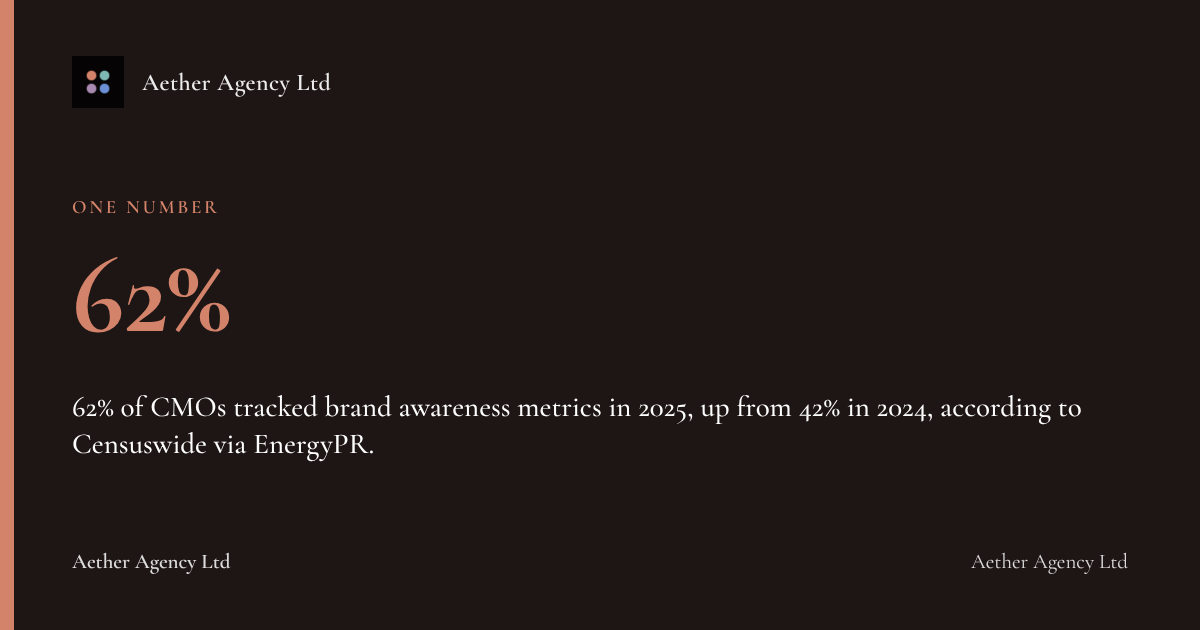
Measuring brand awareness means tracking whether people recognise and recall your brand, using a mix of surveys (aided and unaided recall), search data and social listening. In 2025, 62% of CMOs tracked brand awareness metrics, up from 42% in 2024, according to Censuswide via EnergyPR, reflecting growing pressure to prove marketing spend works.
Key Takeaways
- 62% of CMOs tracked brand awareness metrics in 2025, up from 42% in 2024, according to Censuswide via EnergyPR.
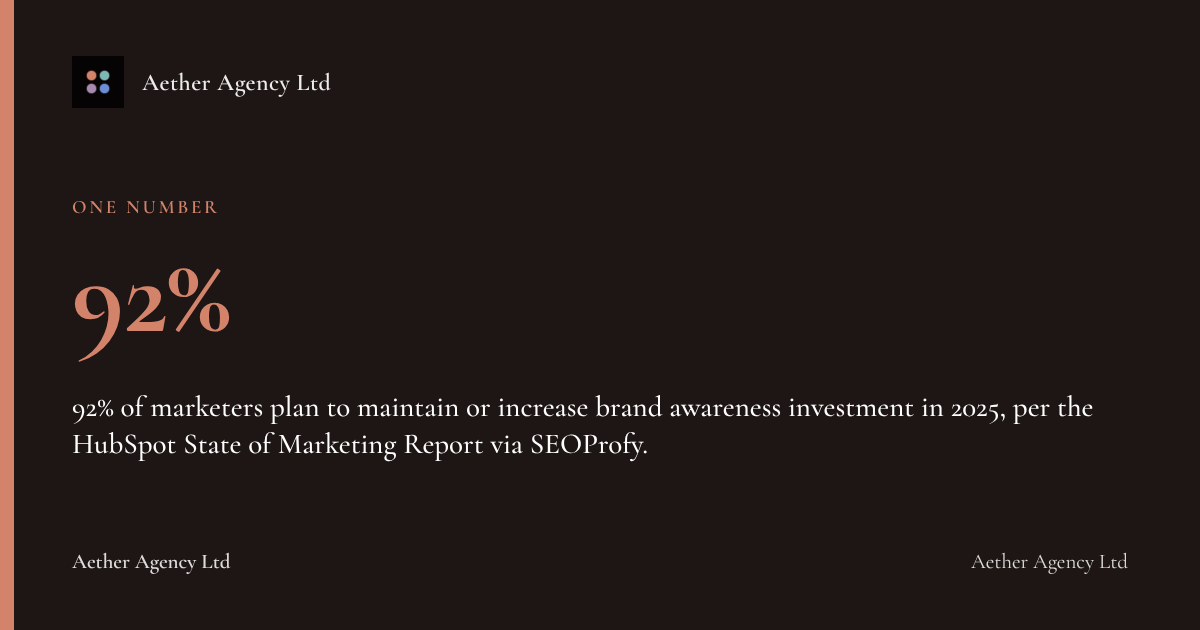
- 92% of marketers plan to maintain or increase brand awareness investment in 2025, per the HubSpot State of Marketing Report via SEOProfy.
- A 10 point excess share of voice correlates with roughly 0.7% annual market share growth in B2C and 0.6% in B2B, according to Les Binet, Peter Field and Ehrenberg-Bass Institute research via Mentient.
- Share of search represented 83% of share of market on average across 30 cases, per IPA research via GrowthX AI.
- 89.8% of CMOs say marketing is primarily responsible for brand visibility, according to SEOProfy, which matters when deciding who owns this metric internally.
What is brand awareness and why does it matter for a business?
Brand awareness is the extent to which potential customers recognise and recall a brand when prompted, or spontaneously, before any purchase decision takes place. It sits at the top of the marketing funnel, above consideration and conversion, and it's the foundation every other commercial outcome rests on, because a business can't be chosen if it isn't known.
For a growing UK business, brand awareness is rarely abstract. It shows up in whether a prospect searches your company name directly instead of a generic term, whether they recognise your logo on a van or packaging, and whether they mention you unprompted when asked who operates in your sector.
The stakes have risen because marketing leaders are under more pressure to justify this spend than ever. 92% of marketers plan to maintain or increase investment in brand awareness in 2025, according to the HubSpot State of Marketing Report via SEOProfy, which means boards expect to see the return, not just the activity.
At Aether Agency Ltd, this is the starting point for every brand identity engagement: a strong identity system only compounds in value if someone is actually measuring whether more people know it exists.
What are the main metrics used to measure brand awareness?
The main metrics for measuring brand awareness are aided recall, unaided recall, share of voice and brand recall within paid media, each capturing a different layer of memory and market presence. Aided recall (also called prompted recall) asks respondents whether they recognise a brand name from a list; unaided recall asks them to name brands in a category without any prompt at all, making it the harder and more valuable test of genuine top-of-mind status.
Share of voice measures a brand's proportion of total category advertising, PR or social conversation relative to competitors. This matters because of a well-established finding in effectiveness research: a 10 point excess share of voice (share of voice minus share of market) correlates with roughly 0.7% annual market share growth in B2C and 0.6% in B2B, according to Les Binet, Peter Field and Ehrenberg-Bass Institute research via Mentient.
The practical implication is that a brand spending (or appearing) proportionally more than its current market share tends to grow, while one punching below its weight tends to shrink. This is backed by IPA research via Meltwater, which found that brands with share of voice above their current market share tend to grow, while those below it tend to decline.
Brand recall also plays a measurable role within campaign-level brand lift studies. Brand recall accounts for 38.7% of brand lift, the single biggest driver of brand lift in emerging media, according to CoS Research. This is why a campaign's media plan and its measurement plan should be designed together, not bolted on afterwards.
| Metric | What it measures | Typical method |
|---|---|---|
| Unaided recall | Spontaneous top-of-mind awareness | Open-ended survey question |
| Aided recall | Recognition when prompted | Multiple-choice survey question |
| Share of voice | Proportion of category conversation/spend | Media monitoring, ad spend tracking |
| Share of search | Proportion of category search volume | Google Trends, keyword tools |
| Brand lift | Change in awareness from a specific campaign | Control vs exposed group survey |
What survey methods can I use to measure brand awareness among UK consumers?
Survey-based brand tracking uses structured questionnaires sent to a representative sample of UK consumers, typically asking unaided recall questions first, then aided recognition, then brand attribute questions. The classic approach is a "brand tracker": a recurring survey run quarterly or biannually with a consistent panel structure, so results are comparable wave on wave rather than being a one-off snapshot.
A well-designed brand awareness survey typically opens with "Which [category] brands have you heard of?" as an unprompted question, before showing a list of named competitors and asking which the respondent recognises. Platforms built for this, such as Attest, let UK businesses run nationally representative panels without commissioning a full agency-led study, which brings this kind of research within reach for mid-sized businesses rather than only FTSE 250 brands.
Sample size matters more than most businesses assume. A survey of 200 UK respondents carries a wide margin of error on a category-level recall question, while 1,000+ respondents, segmented by region or age bracket, gives results stable enough to compare across quarters. For a niche B2B category with a small total addressable market, this creates a genuine constraint, because there simply aren't enough buyers to survey at scale, which is why share of voice and search-based proxies often carry more weight than consumer-style surveys in B2B measurement.
Nielsen's brand lift methodology offers a more rigorous alternative: a control group that hasn't seen a campaign is compared against an exposed group that has, isolating the awareness gain the campaign itself produced. This control vs exposed structure is the gold standard for proving a specific campaign moved the needle, rather than awareness drifting for unrelated reasons.
How can I measure brand awareness using social media and search data?
Social listening and branded search tracking measure brand awareness indirectly, by counting how often a brand is mentioned, searched for or discussed without running a formal survey. Social listening tools scan platforms for brand name mentions, sentiment and share of voice relative to named competitors, giving a rolling, low-cost proxy for awareness that updates daily rather than quarterly.
Branded search volume, meaning the number of people searching your exact company name on Google each month, is one of the clearest behavioural signals available, because someone only searches a brand name if they already know it exists. Google Trends and Google Search Console both surface this data for free, making it the most accessible starting point for any business without a research budget.
Share of search, a related concept, compares your branded search volume against the combined branded search volume of your competitors. IPA research via GrowthX AI found that share of search represented 83% of share of market on average, across 30 cases, 12 categories and seven countries, making it one of the strongest publicly validated proxies for real market share currently available to marketers without enterprise research budgets.
Sponsored and branded content also plays a measurable role here. Capital One Shopping's branding statistics analysis found that sponsored content can improve brand awareness by up to 10%, and that 71% of audiences can recall the brand featured in branded content without prompting, which is a meaningful data point for any business weighing paid partnerships against owned content.
Generative AI answer engines are adding a further layer: whether ChatGPT, Perplexity or Google's AI Overviews mention a brand by name when answering category questions is becoming its own measurable form of "AI share of voice." Aether Agency Ltd tracks this through its AI Search Marketing (GEO) service, monitoring citation frequency the same way a PR team once tracked press mentions.
How much does it cost to run a brand awareness measurement study in the UK, and who owns it?
Brand awareness measurement in the UK ranges from free (Google Trends, Search Console, manual social monitoring) to several thousand pounds for a commissioned survey panel, with ongoing tracker subscriptions sitting in between. A single-wave survey of 1,000 UK respondents through a self-serve platform typically costs in the low thousands of pounds, while a recurring quarterly brand tracker with a research agency, including analysis and reporting, runs considerably higher across a year.
| Approach | Typical cost range | Best suited to |
|---|---|---|
| Free tools (Trends, Search Console, social monitoring) | £0 | Early-stage businesses, ongoing monitoring |
| Self-serve survey platform (one wave) | Low thousands | Mid-sized businesses needing a benchmark |
| Agency-run brand tracker (quarterly) | Mid to high thousands per year | Established brands with board-level reporting needs |
| Enterprise panel (e.g. Kantar, YouGov BrandIndex) | Higher, ongoing subscription | Large consumer brands tracking continuously |
Within most UK companies, responsibility for brand awareness measurement sits with the marketing team rather than being outsourced wholesale. 89.8% of CMOs say that marketing at their company is primarily responsible for brand visibility, according to SEOProfy, though many still bring in an agency to design the survey instrument, run the media monitoring, or interpret share of voice data against effectiveness benchmarks such as those from the Ehrenberg-Bass Institute.
How do I benchmark brand awareness and avoid common measurement mistakes?
Benchmarking brand awareness means comparing your recall, recognition and share of voice figures against named competitors in the same category, ideally using the same methodology each time. Without a competitor comparison, a brand awareness figure on its own, say "34% unaided recall", tells you very little, because there's no reference point for whether that's strong or weak for your category size and marketing spend.
The most common mistake UK businesses make is tracking brand awareness inconsistently: switching survey providers, changing the wording of recall questions, or measuring only occasionally, which destroys the wave-on-wave comparability that makes a tracker useful in the first place. A second common error is confusing reach (how many people saw an ad) with awareness (whether they remember the brand afterwards), which are related but distinct measures.
A third mistake is measuring brand awareness in isolation from business outcomes. Share of voice research is instructive here: IPA research via Meltwater found that brands with share of voice above their current market share tend to grow, while those below it tend to decline, which means awareness tracking only becomes genuinely useful once it's plotted against sales, enquiries or market share over time, not read as a standalone vanity metric.
When Renton Dance Studio, a UK dance academy, approached Aether Agency Ltd, its traditional digital presence simply wasn't registering with a younger audience it needed to reach. Aether Agency Ltd delivered a full rebrand, website redesign and social media content programme, moving the studio's brand and website from traditional to modernised, a reminder that awareness problems often start with an identity that doesn't match the audience you're trying to reach in the first place.
Your brand awareness measurement checklist
- Define your category and list 3 to 5 named competitors to benchmark against.
- Choose at least one survey-based metric (aided or unaided recall) and one behavioural metric (branded search, share of voice).
- Set a fixed measurement cadence, quarterly or biannually, and keep question wording identical each wave.
- Track branded search volume for free using Google Trends and Google Search Console.
- Calculate your share of voice against named competitors using media monitoring or social listening data.
- Plot awareness movement against sales, enquiries or market share, not in isolation.
- Assign clear ownership, typically the marketing team, with an agency brief for survey design or media monitoring if needed.
- Review results against the Ehrenberg-Bass Institute excess share of voice benchmark to judge whether current spend supports growth.
FAQ
How do you measure brand awareness?
You measure brand awareness using a combination of survey-based recall questions (aided and unaided), share of voice tracking, branded search volume and social listening data. Most UK businesses combine at least two of these, a qualitative survey metric and a quantitative behavioural metric, to get a rounded picture rather than relying on one number.
What is the difference between aided and unaided brand awareness?
Unaided (or spontaneous) awareness asks respondents to name brands in a category with no prompt, measuring genuine top-of-mind status. Aided (or prompted) awareness shows respondents a list of brand names and asks which they recognise, which typically produces a higher score because recognition is an easier mental task than recall.
What is the KPI for brand awareness?
There's no single universal KPI; most brand trackers use unaided recall percentage, aided recall percentage and share of voice as the core three. A business tracking campaign-specific awareness lift will also use a brand lift score, comparing a control group against an exposed group.
How often should a business re-measure brand awareness?
Quarterly or biannual measurement is typical for businesses running a formal tracker, since this cadence balances cost against the need to spot trends early. Behavioural proxies like branded search volume and social mentions can be monitored monthly or even continuously using free tools, supplementing the less frequent survey waves.
What tools are available in the UK to track brand awareness?
UK businesses commonly use Google Trends and Google Search Console for free search-based tracking, self-serve platforms such as Attest for survey panels, and enterprise options including YouGov BrandIndex and Kantar for continuous large-scale tracking. Social listening tools such as Brandwatch add real-time mention and sentiment monitoring on top of these.
How do I link brand awareness to actual sales or loyalty?
Link brand awareness to business outcomes by plotting your recall or share of voice figures against sales, enquiry volume or customer retention over the same periods. The Ehrenberg-Bass Institute research via Mentient found that a 10 point excess share of voice correlates with roughly 0.7% annual market share growth in B2C, giving a reference point for what a healthy relationship between awareness and growth looks like.
Who should be responsible for brand awareness measurement in a UK company?
Responsibility typically sits with the marketing team, with 89.8% of CMOs saying marketing is primarily responsible for brand visibility, according to SEOProfy. Many businesses still bring in an external agency to design surveys, run media monitoring, or build out the brand identity that underpins what's being measured in the first place.
Measuring what your brand identity actually achieves, with Aether Agency Ltd
Measurement only matters once there's a brand worth measuring, which is where most of Aether Agency Ltd's work begins. Businesses regularly arrive with a recognisable local reputation but no coherent identity system to track awareness of in the first place, which was precisely the starting point for Fulk Butchers, an award-winning family butcher in Surrey.
Aether Agency Ltd built Fulk Butchers a full brand identity from scratch, alongside an e-commerce website and ongoing social media support, and the business has gone on to record a 4.8 star Google rating and online sales up 180%. That's the kind of outcome a brand awareness tracker is designed to pick up: recognition and recall converting into measurable commercial activity.
If your business needs a brand identity strong enough to be worth tracking, or a measurement framework built around one that already exists, Aether Agency Ltd's Brand Identity service is the place to start a conversation. Get in touch with Aether Agency Ltd to discuss a brand audit and measurement plan suited to your sector and budget.
Related Reading
- Brand Strategy Agency London: 2026 Costs & Guide
- Brand Strategy Agency Richmond: A UK Buyer's Guide 2026
- How to Conduct a Brand Audit: UK Guide 2026
Add aether-agency.co.uk as a preferred source on Google
See How Your Brand Appears in AI Search
Aether AI monitors your visibility across ChatGPT, Perplexity, Google AI Overviews, and Claude in real time. Find out where you stand and what to fix.
Explore Aether AI