Last updated: 7 September 2026
The best GEO (Generative Engine Optimisation) tools for 2026 include BrightEdge, MarketMuse, Clearscope and Surfer SEO, with enterprise platforms starting from £450/month and SME solutions from £79/month. GEO tools optimise content specifically for citation by AI answer engines such as ChatGPT, Perplexity and Google AI Overviews (Google's AI-generated summary panel shown above traditional search results), rather than for traditional link-based ranking.
Key Takeaways
- GEO tools optimise content for AI search engines like ChatGPT, Perplexity and Claude, measuring factors such as fact density and citation-worthiness rather than keyword placement.
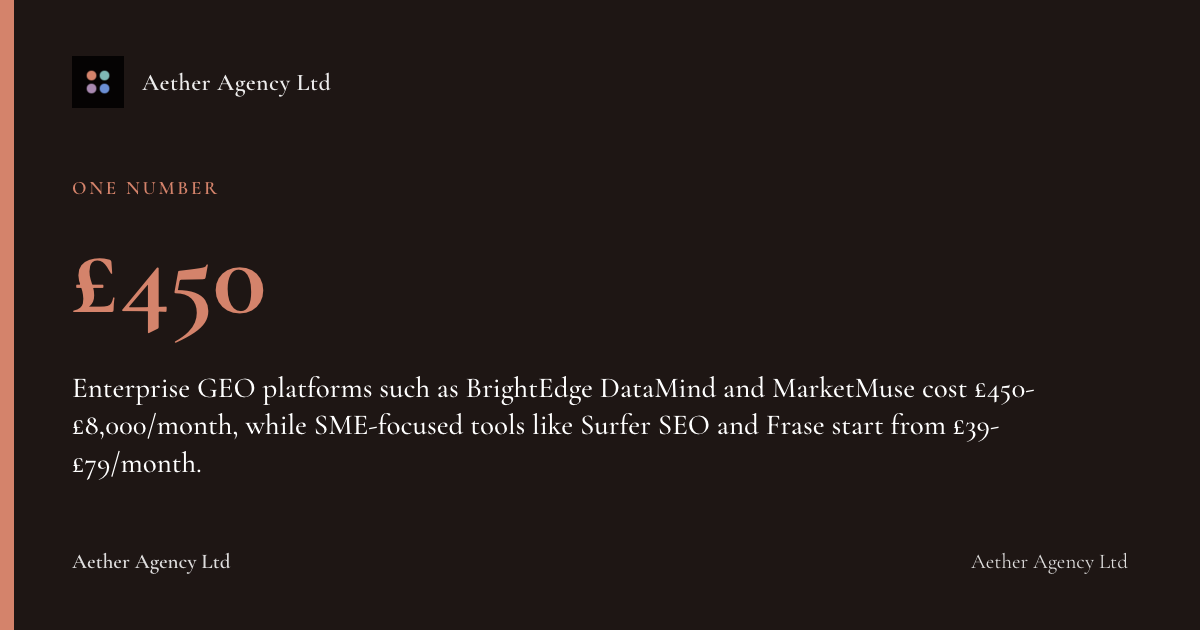
- Enterprise GEO platforms such as BrightEdge DataMind and MarketMuse cost £450-£8,000/month, while SME-focused tools like Surfer SEO and Frase start from £39-£79/month.
- Fact density (the number of verifiable statistics and figures per 100 words) is widely cited by GEO practitioners as a strong predictor of AI citation rates, and several tools compared here calculate this metric automatically.
- Hybrid tools combining traditional SEO with GEO capabilities, such as Frase and Surfer SEO, offer accessible entry points for UK SMEs without requiring separate toolsets.
- Aether Agency Ltd has managed 744 published articles across client accounts and refreshed 134 existing client articles to date, applying GEO structuring principles such as those described in this guide.
What Is GEO and Why Do Dedicated Tools Matter in 2026?
Generative Engine Optimisation (GEO) is the practice of structuring content so that AI language models can extract, synthesise and attribute it correctly when generating direct answers to user queries, rather than optimising primarily for ranked search results. GEO tools automate the analysis needed to do this at scale, measuring factors that traditional SEO software does not track.
The distinction matters because AI chatbots and AI Overviews answer questions differently from a traditional search results page. Instead of returning ten ranked links, ChatGPT, Perplexity and Google's AI Overviews synthesise information from multiple sources into a single response and cite (or fail to cite) the sources they draw from. Earning that citation requires different techniques from ranking on page one of Google: structured data, citation-friendly formatting, fact density and demonstrable source authority all play a role.
Dedicated GEO tools evaluate these factors automatically. They measure fact density (statistics per 100 words), assess the citation-worthiness of individual sentences, check whether content answers questions in self-contained chunks, and benchmark a piece against content that AI engines already cite. Doing this manually, sentence by sentence across a large content library, is possible but slow — which is why GEO tool adoption has grown among UK agencies through 2026. For a deeper look at how agencies benchmark this citation performance, see Profound vs Share of Model: AI Benchmarking Compared 2026.
How Do GEO Tools Differ from Traditional SEO Platforms?
GEO tools and traditional SEO platforms measure different things: SEO platforms like Ahrefs, Semrush and Moz track backlinks, domain authority, keyword placement and technical site health, while GEO tools track citation probability, fact density and answer completeness. Google (still the dominant source of UK search traffic) continues to reward the former; AI answer engines reward the latter.
GEO tools analyse citation probability — the likelihood an AI model will extract and attribute a specific passage. They measure answer completeness (whether a section fully answers its heading question within roughly 130-160 words, a length AI systems commonly extract as a single "chunk"). They also evaluate fact density, source-attribution quality, and whether key sentences are self-contained enough to make sense when quoted in isolation, away from their surrounding paragraph.
Consider a practical example. A traditional SEO tool might flag that an article on "construction safety regulations" needs more backlinks and a faster load time. A GEO tool would instead flag that the opening paragraph doesn't directly answer the title question, that statistics lack inline source attribution, that H2 sections don't open with self-contained answer passages, and that fact density falls below the level associated with frequently-cited content.
Some platforms now offer both types of analysis. BrightEdge, MarketMuse and Clearscope have added GEO modules to their existing SEO platforms. Others, such as Frase and Surfer SEO, built hybrid tools combining both from the outset. Pure-play GEO tools like Otterly.ai focus exclusively on AI search monitoring, offering deeper GEO-specific functionality but no traditional SEO features. Many UK marketing teams now run both toolsets in parallel, with separate workflows for each — a pattern explored further in GEO Providers UK 2026: How to Choose the Right Agency.
Top 11 GEO Tools for UK Businesses in 2026
1. BrightEdge DataMind (Enterprise)
BrightEdge's DataMind platform tracks AI citations in real time across ChatGPT, Claude, Perplexity and Google AI Overviews. The platform monitors which pages are being cited, tracks share-of-voice in AI answers for target queries, and generates recommendations to improve citation rates.
Key features: AI citation tracking, competitor citation analysis, automated fact-density scoring, source attribution audits, integration with 40+ content management systems.
Pricing: £2,400-£8,000/month depending on query volume and user seats.
Best for: Enterprise organisations with dedicated content teams and annual search optimisation budgets above £30,000.
2. MarketMuse (Mid-Market to Enterprise)
MarketMuse pairs AI-powered content optimisation with GEO capabilities added in late 2026. The platform analyses top-performing content across both traditional search and AI engines, then produces content briefs designed to optimise for both simultaneously.
Key features: Dual SEO/GEO scoring, competitive content gap analysis, fact-density recommendations, automated expert quote suggestions, topic cluster planning.
Pricing: £450-£1,800/month depending on team size and content volume.
Best for: Content-heavy businesses producing 20+ articles monthly, B2B companies, publishers and agencies managing multiple clients.
3. Clearscope (SME to Mid-Market)
Clearscope provides real-time content grading as you write, with separate scores for traditional SEO and GEO metrics, and is known for one of the more intuitive interfaces among professional GEO tools.
Key features: Real-time content grading, readability analysis, question-based heading suggestions, citation-probability scoring for individual paragraphs, Google Docs integration.
Pricing: £149-£399/month depending on user seats and content volume.
Best for: SMEs, content agencies and marketing teams without dedicated SEO specialists who need clear, actionable guidance.
4. Surfer SEO (SME)
Surfer SEO added GEO capabilities to its existing SEO platform in 2026, creating a hybrid tool at an accessible price point. The platform analyses both traditional ranking factors and AI-citation factors within a single content editor.
Key features: Combined SEO/GEO scoring, SERP analysis, AI-answer analysis, content editor with real-time suggestions, plagiarism detection.
Pricing: £79-£219/month depending on features and content volume.
Best for: Small businesses, solo consultants and agencies serving SME clients who need professional capabilities at accessible prices.
5. Frase (SME)
Frase focuses specifically on question-based content and FAQ optimisation — the content formats AI engines most frequently cite. The platform identifies what questions users ask about a topic, then helps structure content to answer those questions in citation-friendly formats.
Key features: Question research, AI-powered content briefs, answer-optimisation scoring, FAQ schema generation, chat-based content assistant.
Pricing: £39-£99/month depending on features and content volume.
Best for: Service businesses, local businesses and anyone creating FAQ-heavy or educational content, including legal, financial and professional service firms whose enquiries are often question-shaped.
6. Otterly.ai (Pure-Play GEO)
Otterly.ai tracks a brand's visibility in AI-generated answers across multiple platforms. Unlike hybrid tools, Otterly focuses exclusively on monitoring and improving AI citations, making it a natural complement to an existing SEO toolset rather than a replacement for one.
Key features: AI citation monitoring, brand mention tracking across ChatGPT/Claude/Perplexity, competitor citation analysis, citation-opportunity identification.
Pricing: £180-£600/month depending on tracked queries and competitor count.
Best for: Brands prioritising AI search visibility and reputation management, and organisations already satisfied with their traditional SEO tools but lacking AI citation visibility.
7. GEOranker (UK-Focused)
GEOranker, developed by a Manchester-based team specifically for the UK market, optimises content for UK English, local regulations and regional search patterns. The platform includes UK-specific fact-checking against sources such as gov.uk and the Office for National Statistics (ONS).
Key features: UK-specific optimisation, gov.uk citation integration, regional content scoring, British English grammar checking, UK regulatory compliance checks.
Pricing: £120-£340/month depending on features and content volume.
Best for: UK-focused businesses, regulated industries (legal, financial, healthcare) and organisations creating region-specific content.
8. NeuronWriter (Budget-Friendly)
NeuronWriter offers GEO capabilities at the lowest price point in this comparison. It lacks some advanced features of premium platforms but covers the essentials — content scoring, competitor analysis and fact density — and includes unlimited content projects.
Key features: Content scoring, competitor analysis, semantic recommendations, fact-density calculation, Google NLP integration.
Pricing: £19-£69/month with unlimited projects.
Best for: Startups, solo content creators and businesses testing GEO on a limited budget before committing to a larger platform.
9. Copy.ai (AI-Powered Writing with GEO)
Copy.ai, primarily known as an AI writing assistant, added GEO capabilities in 2026. The platform analyses content for citation-worthiness while generating or editing text, combining content creation and optimisation in one workflow.
Key features: AI writing assistance, built-in GEO scoring, citation-structure templates, fact-checking suggestions, multi-language support.
Pricing: £36-£186/month depending on features and word count limits.
Best for: Content teams focused on volume production, agencies creating content for multiple clients, and organisations wanting writing assistance and GEO scoring in one platform.
10. Semrush Writing Assistant with GEO Module (Add-On)
Semrush added GEO capabilities as an optional module to its existing SEO platform in late 2026. For organisations already using Semrush for keyword research and rank tracking, this offers the most direct path to GEO adoption without changing tools.
Key features: Integrated with existing Semrush SEO data, real-time content scoring, readability analysis, tone-of-voice consistency checking, plagiarism detection.
Pricing: £10-£40/month added to an existing Semrush subscription (which starts at £99/month).
Best for: Existing Semrush users, agencies with established SEO workflows and organisations wanting minimal workflow disruption.
11. Ahrefs Webmaster Tools with AI Insights (Free Tier Available)
Ahrefs released free AI citation tracking in early 2026 as part of its Webmaster Tools offering. It is less comprehensive than dedicated GEO platforms but provides basic citation monitoring at no cost, making it a reasonable starting point before committing budget elsewhere.
Key features: Free AI citation monitoring, basic content recommendations, site audit with GEO factors, limited keyword research.
Pricing: Free tier available; paid plans from £83/month.
Best for: Small businesses testing GEO before committing to paid tools, organisations with minimal budgets, and anyone wanting basic citation visibility as a first step.
The free tier's limitations are notable: it tracks only your own site, not competitors, and its recommendations are more basic than those from dedicated GEO tools. Even so, for initial GEO awareness and citation monitoring it offers genuine value at zero cost.
GEO Tool Pricing Comparison 2026
| Tool | Entry Price | Mid-Tier | Enterprise | Best For |
|---|---|---|---|---|
| BrightEdge DataMind | £2,400/mo | £4,800/mo | £8,000+/mo | Large enterprises, 100+ content pieces/month |
| MarketMuse | £450/mo | £900/mo | £1,800+/mo | Content-heavy B2B, publishers |
| Clearscope | £149/mo | £249/mo | £399/mo | Agencies, mid-market brands |
| Surfer SEO | £79/mo | £149/mo | £219/mo | SMEs, small agencies |
| Frase | £39/mo | £79/mo | £99/mo | Service businesses, FAQ content |
| Otterly.ai | £180/mo | £360/mo | £600/mo | Brand monitoring, reputation management |
| GEOranker | £120/mo | £220/mo | £340/mo | UK-focused businesses |
| NeuronWriter | £19/mo | £42/mo | £69/mo | Startups, budget-conscious buyers |
| Copy.ai | £36/mo | £99/mo | £186/mo | High-volume content production |
| Semrush (GEO add-on) | £109/mo | £199/mo | £399+/mo | Existing Semrush users |
| Ahrefs (GEO features) | Free | £83/mo | £332+/mo | Basic monitoring, testing GEO |
Prices shown are for annual billing; monthly billing typically 20-30% higher. All prices exclude VAT.
What Features Should You Prioritise in a GEO Tool?
The single highest-priority feature in a GEO tool is real-time citation tracking, followed by fact-density calculation and source-attribution auditing. Businesses that can see which pages are actually being cited, and by which AI platform, can adjust their content strategy based on evidence rather than guesswork.
Real-time citation tracking tops the priority list because it closes the feedback loop: tools that show which pages are cited, in which AI platforms, and for which queries let a team act on real performance data instead of optimising blind.
Fact-density calculation ranks second. GEO practitioners consistently point to fact density (verifiable statistics, dates and figures per 100 words) as a strong predictor of citation rates. Tools that calculate this automatically and suggest where to add supporting facts save time while directly improving the metric that appears to matter most.
Source attribution auditing matters particularly for UK businesses in regulated industries. Financial services, legal, healthcare and professional services firms — covered further in AI Search Marketing in Professional Services | 2026 Guide — face obligations around factual accuracy. GEO tools that flag unsupported claims and suggest authoritative UK sources such as gov.uk or the ONS reduce compliance risk while improving citation-worthiness.
Competitor citation analysis shows which competitors are being cited for target queries and what they do differently, shortening the learning curve for a team new to GEO.
Answer-completeness scoring checks whether H2 sections open with self-contained 130-160 word passages that fully answer the section question — the length AI engines most commonly extract as a single citable chunk.
Integration capabilities — with Google Docs, WordPress, HubSpot or an existing CMS — determine whether a tool actually gets used day to day, or sits unopened after the trial period ends.
How to Implement GEO Tools in Your Content Workflow
Implementing GEO tools successfully requires process changes alongside the software itself: an initial content audit, a separated SEO/GEO workflow, minimum quality thresholds, writer training and GEO requirements built into content briefs. Skipping these steps and simply installing a tool tends to produce inconsistent results.
Start with audit, not creation. Most organisations begin by auditing existing high-value content — service pages, thought leadership and articles targeting high-intent queries. Running the top 20-30 pages through a GEO tool typically reveals quick wins: sections lacking self-contained answers, statistics without sources, FAQ answers that don't directly address the question asked.
Establish separate SEO and GEO workflows. Optimising for both simultaneously in a single pass tends to produce confused, suboptimal results for each. A more reliable pattern is a traditional SEO pass first (keywords, structure, technical factors), followed by a dedicated GEO pass focused on citation-worthiness, fact density and answer completeness.
Set minimum thresholds, not perfection targets. GEO tools often score content on 100-point scales, and chasing a top score produces diminishing returns. Setting an organisational minimum — for example, "all strategic content must score 75+ before publication" — balances quality against the time cost of over-optimising.
Train writers on principles, not just tools. Writers who understand why fact density matters, why self-contained sentences aid citation, and why source attribution builds authority tend to produce stronger first drafts that need fewer revision cycles.
Integrate GEO metrics into content briefs. Building requirements into the brief itself — "include one statistic per 100 words," "open each H2 with a 130-160 word self-contained answer," "cite sources inline for all statistics" — front-loads optimisation into the creation phase rather than treating it as post-production cleanup.
Common GEO Tool Implementation Mistakes to Avoid
The most common GEO implementation mistakes are choosing tools for their feature list rather than workflow fit, optimising for tool scores instead of business outcomes, neglecting traditional SEO, expecting instant results, and skipping subject-matter-expert review of AI-optimised content.
Mistake 1: Choosing tools based on features rather than workflow fit. Enterprise platforms with extensive feature sets can end up underused if they don't fit an existing workflow. A simpler tool that integrates cleanly with existing systems typically delivers better real-world results than a feature-rich platform that requires a separate login and process.
Mistake 2: Optimising for GEO scores rather than business outcomes. A high-scoring piece on a low-value topic delivers less business impact than a moderately-scoring piece on a high-intent query. Prioritise GEO optimisation for content that matters commercially — service pages, high-value keywords and thought leadership — rather than optimising everything uniformly.
Mistake 3: Ignoring traditional SEO. Google still drives the large majority of UK search traffic. GEO complements SEO rather than replacing it, so existing SEO practices should continue alongside any new GEO workstream.
Mistake 4: Expecting immediate results. AI search engines update their training data periodically rather than continuously, so newly optimised content can take several weeks to appear in AI citations as models retrain and index new content. Set expectations with stakeholders accordingly.
Mistake 5: Optimising in isolation from subject matter experts. GEO optimisation increases fact density, which depends on access to accurate data. Content teams optimising without subject matter expert input risk adding facts that are technically accurate but misleading in context, or citing sources that don't actually support the claim made — a particular risk in technical or regulated topics.
Your GEO Tool Selection Checklist
Use this practical checklist when evaluating GEO tools for your organisation:
- Measure current content volume (pieces per month) and calculate whether usage-based pricing makes sense
- Identify which AI platforms matter most to your audience (ChatGPT, Perplexity, Claude, Google AI Overviews)
- Determine whether you need citation tracking (monitoring), optimisation recommendations (improvement), or both
- Confirm the tool tracks or optimises for the specific AI platforms your audience uses most, and includes fact-density calculation
- Check whether competitor citation analysis is available at your price tier, and test the interface with a trial or demo
- Verify integration with your content management system (WordPress, HubSpot, Contentful, etc.) and existing workflow
- Add up subscription costs, onboarding time and per-piece optimisation time (typically 20-45 minutes) to calculate total cost of ownership
- Run a pilot on 10-15 representative pieces of content and measure citation rate changes after 8-12 weeks before committing to an annual contract
FAQ
What is the difference between SEO and GEO tools?
SEO tools optimise content for traditional search engines like Google by focusing on keywords, backlinks, page speed and technical site health. GEO tools optimise content for AI search engines like ChatGPT and Perplexity by focusing on citation-worthiness, fact density, source attribution and answer completeness. Most UK businesses now use both, since traditional search still drives the majority of UK search traffic while AI search continues to grow.
How much do GEO tools cost in the UK?
GEO tool pricing ranges from free (Ahrefs Webmaster Tools' basic tier) to £8,000+/month for enterprise platforms like BrightEdge. Mid-market tools such as Clearscope and Surfer SEO cost £79-£399/month, which suits most UK SMEs. Annual billing typically saves 20-25% compared to monthly subscriptions.
Do I need a GEO tool if I already use SEO tools?
Yes, if AI search visibility matters to your business, because SEO and GEO tools measure different metrics and optimise for different algorithms. However, if your audience relies exclusively on traditional search, or you operate a highly local business where AI search isn't yet a meaningful referral source, a dedicated GEO tool may not be an immediate priority.
How long does it take to see results from GEO optimisation?
Most organisations see measurable citation rate changes several weeks to a few months after implementing GEO optimisation, because AI models retrain periodically rather than continuously. Results typically continue to develop over 6-12 months as more content is optimised and models retrain multiple times.
Can I optimise content for both Google and AI search simultaneously?
Yes, but it requires deliberate process design. The most effective approach is a two-pass workflow: optimise for traditional SEO first (keywords, structure, technical factors), then run a dedicated GEO pass focused on citation-worthiness, fact density and source attribution. This adds time to content production but tends to improve results for both SEO and GEO compared with attempting both at once.
Which GEO tool is best for UK small businesses?
Surfer SEO (£79-£219/month) and Frase (£39-£99/month) offer strong value for UK small businesses, providing GEO capabilities at accessible prices with training resources and CMS integrations that don't require in-house SEO expertise.
Do GEO tools work for all industries and content types?
GEO tools tend to deliver the strongest results for informational and educational content — articles, guides, how-tos and thought leadership. B2B, professional services, healthcare, finance and technology sectors often see stronger citation improvements because their content is naturally fact-rich and answers specific questions, whereas e-commerce product descriptions and highly visual content are cited less frequently by AI engines overall.
Optimising Your Content for AI Search with Aether Agency Ltd
Choosing a GEO tool is only half the task described in this guide — the other half is applying its recommendations consistently across a content library, which is where many in-house teams run out of time. Aether Agency Ltd is a full-service creative studio covering brand identity, website development and marketing designed to get clients found on Google, ChatGPT and Perplexity, combining the tool-driven analysis covered above with hands-on content and technical implementation.
As one proof point from Aether Agency Ltd's own client data: articles refreshed and republished under the agency's current content structure achieve an average Google position of 12.8, compared with 20.7 for the same clients' older pages, alongside a click-through rate of 0.41% versus 0.15% on those older pages. That comparison illustrates the kind of gain GEO-aware restructuring — audit, fact-density review, self-contained answer sections — can produce when applied to an existing content library rather than only to new pages.
If you're evaluating GEO tools and want a second opinion on which platform, or which combination of platform and agency support, fits your content volume and budget, get in touch with Aether Agency Ltd for a review of your top pages and a recommendation tailored to your existing workflow.
Related Reading
- How to Show Up in AI Search: 2026 GEO Strategies That Work
- How to Increase Brand Visibility in AI Search 2026 | Aether
- AI Search Optimisation Agency UK: Complete 2026 Guide
- UK Agencies for ChatGPT & Gemini Visibility (2026)
Add aether-agency.co.uk as a preferred source on Google
See How Your Brand Appears in AI Search
Aether AI monitors your visibility across ChatGPT, Perplexity, Google AI Overviews, and Claude in real time. Find out where you stand and what to fix.
Explore Aether AI