Last updated: 16 November 2026
Property developer website design is the process of building a site that turns scheme visitors into reserved plots, not just page views. The average real estate website converts just 2.2% of visitors into leads, according to First Page Sage via wpresidence.net (2025), yet developer-specific sites can push conversion closer to 2.45% when the structure, imagery and enquiry journey are built with buyers in mind.
Key Takeaways
- Developer sites convert at 2.45% on average, against 0.62% for agencies and 3.34% for commercial property sites, according to Uprealer's analysis of 126 to 147 real estate company websites (2020).
- Most home buyers now use the internet during their property search, making a slow or dated scheme site a direct barrier to reservations.
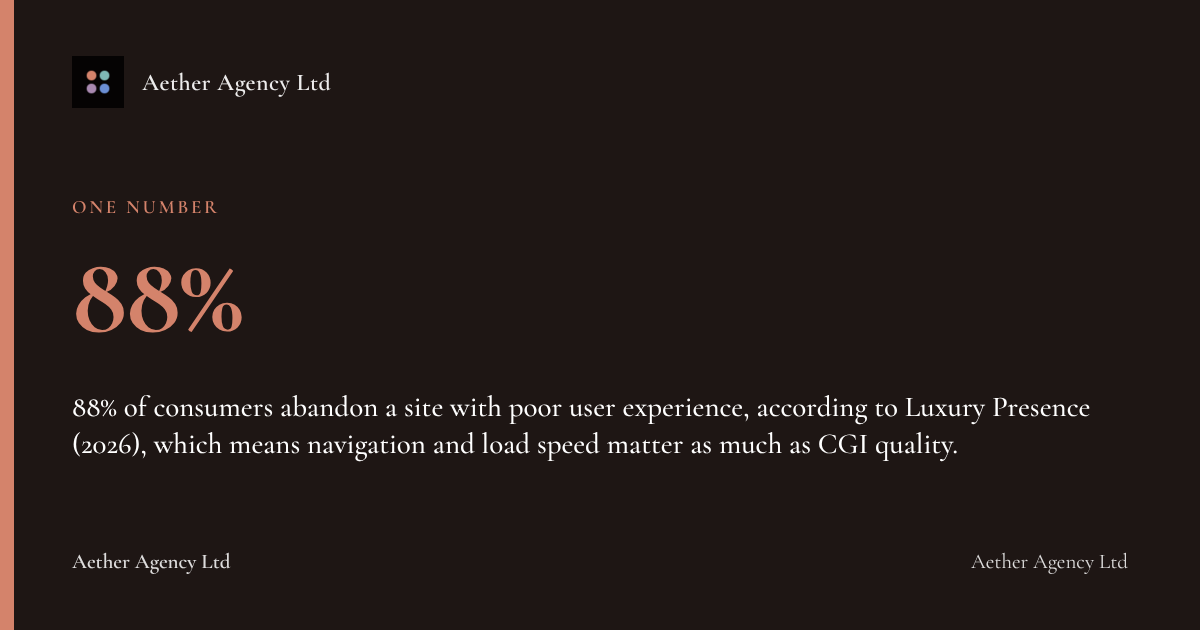
- 88% of consumers abandon a site with poor user experience, according to Luxury Presence (2026), which means navigation and load speed matter as much as CGI quality.
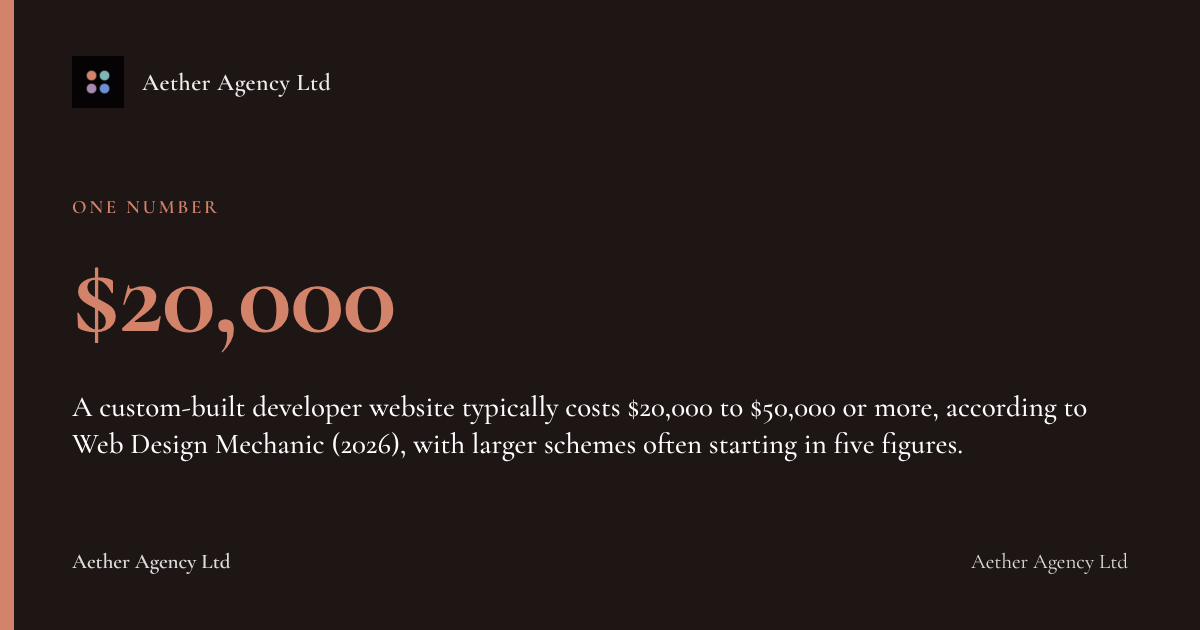
- A custom-built developer website typically costs $20,000 to $50,000 or more, according to Web Design Mechanic (2026), with larger schemes often starting in five figures.
- Aether Agency Ltd's work for Just Simple Homes, a property developer, recorded site traffic up 85% after website development, branding and ongoing social media management.
What is property developer website design?
Property developer website design is the specialist discipline of planning, building and optimising a website for a house builder or development company, distinct from a standard estate agency site because it must sell schemes that do not physically exist yet. Where an estate agency site lists individual resale properties, a developer site has to carry CGI renders, phased release plans, floor plans and reservation workflows for homes still under construction or in planning.
This distinction matters because the buyer journey is longer and higher-stakes. A buyer reserving an off-plan flat in Manchester or a new estate in Surrey is committing to a purchase based on visualisations, specification sheets and trust in the developer's brand, not a walk-through of finished rooms.
Most home buyers now use the internet during their property search. For a developer, that means the website is frequently the first and sometimes only brand touchpoint before a buyer contacts a sales office or attends a show home viewing.
Property developer website design also needs to serve multiple distinct audiences from one platform: owner-occupiers, buy-to-let investors, overseas buyers and the estate agents who refer business. Each group searches differently and needs different proof points, which is why a generic template built for a single-agent business rarely performs for a multi-scheme developer.
What key features and functionality should a property developer website include?
A property developer website needs scheme finder tools, interactive site plans, floor plan galleries, CGI and photography libraries, and a lead capture form connected to a CRM (customer relationship management system that tracks every enquiry through to reservation). Without these, visitors struggle to self-serve the information that drives reservations.
The core functional layer should include:
- A development or scheme finder filterable by location, bedroom count, price band and availability status
- Interactive site plans showing plot numbers, orientation and which units remain unsold
- A document library for brochures, specification sheets and energy performance certificates (EPCs)
- A reservation or "register interest" form that feeds directly into a CRM rather than a generic inbox
- Live availability indicators, so buyers do not enquire about a plot already sold subject to contract
Among buyers who used the internet, 81% found photos very useful, 77% valued detailed property information, and 57% appreciated floor plans, according to the NAR 2025 Profile of Home Buyers and Sellers via nowbam.com (2025). That ordering is worth noting: photography and detailed specification copy outweigh floor plans in buyer priority, even though floor plans remain a near-universal expectation on any serious scheme page.
A booking or diary integration for show home appointments is increasingly standard too, letting a prospective buyer reserve a viewing slot without a phone call.
How much does it typically cost to design and build a property developer website in the UK?
A custom-built property developer website typically costs $20,000 to $50,000 or more, with larger developer sites often starting in five figures, according to Web Design Mechanic (2026). UK pricing tends to track this range closely, though the final figure depends heavily on how many schemes, CGI assets and bespoke tools the build requires.
| Build type | Typical scope | Approximate cost range (illustrative) |
|---|---|---|
| Template or off-the-shelf platform | Single corporate site, limited customisation, stock imagery layouts | Low thousands to around £5,000 |
| Mid-tier custom build | Branded corporate site plus 2 to 4 scheme landing pages, CRM integration | £8,000 to £20,000 |
| Full custom build with CGI/VR tools | Multi-scheme portfolio, interactive site plans, virtual tours, bespoke CMS | £20,000 to £50,000+ |
| Dedicated scheme microsite (per development) | Standalone site for a single flagship scheme, often time-limited | £5,000 to £15,000 per site |
These bands are illustrative ranges based on typical UK agency scoping, not a single sourced figure, and should be treated as a starting point for budget conversations rather than a quote. Costs rise sharply once a developer wants bespoke 3D walkthroughs, live stock feeds from a sales CRM, or multilingual pages for overseas investor audiences.
It is worth separating one-off build cost from ongoing cost. Most developer sites need continued investment in new scheme pages, CGI updates as phases release, and search visibility work, which is typically priced as a retainer rather than folded into the initial build fee.
What are the must-have pages for showcasing property developments effectively?
The must-have pages for a property developer website are the homepage, individual scheme pages, an about/trust page, a contact and enquiry page, and a resources or FAQ hub. Missing any of these creates friction at exactly the point a buyer is deciding whether to enquire.
Scheme pages are the highest-stakes pages on the entire site. Each one needs its own URL, its own CGI gallery, its own floor plans, its own specification list and its own enquiry form, because buyers frequently arrive directly on a scheme page from a Google search or a portal listing rather than the homepage.
Beyond scheme pages, a developer site needs:
- A homepage that signals portfolio scale, current live schemes and a single clear next step
- An about/track record page showing completed schemes, years trading and any press coverage, since trust signals matter disproportionately for off-plan purchases
- A location or area guide page per scheme, covering transport links, schools and local amenities
- A sustainability or specification page, increasingly expected given rising buyer interest in energy performance
- An investor-specific page if the developer targets buy-to-let or overseas capital, separate from the owner-occupier journey
- A careers or trade page if the developer also recruits contractors or sells to housing associations
- A news or press page demonstrating momentum, launches and planning approvals
"They brief the site they want to look at instead of the site their customer needs to act on. Every page should have one job: answer, reassure, or convert, and a visitor should never have to work out what you sell or what to do next. Beautiful and unclear loses to plain and obvious every single time.", Lauren Dawkins, Head of Content, Aether Agency
That principle applies most sharply on scheme pages, where a visitor deciding between three developments in the same town will leave for a competitor's site the moment they cannot find price, plot availability or a clear enquiry button.
Single corporate site or a dedicated microsite per development?
Developers face a real structural choice: run every scheme from one corporate domain, or build a standalone microsite for each flagship development. Neither option is universally correct, and the decision depends on scheme scale, launch timing and in-house marketing capacity.
| Factor | Single corporate site | Dedicated scheme microsite |
|---|---|---|
| SEO consolidation | Builds one strong domain over time | Splits authority across multiple domains |
| Brand consistency | Easier to maintain one visual identity | Risk of drifting brand tone per launch |
| Launch speed | Slower, needs sign-off within wider site | Can launch fast for a single scheme campaign |
| Cost over time | Lower cumulative cost, one platform to maintain | Higher cumulative cost, multiple platforms |
| Best suited to | Developers with 3+ ongoing schemes | A single flagship or landmark launch |
Most developers with a growing pipeline do better consolidating schemes as subsections of one strong corporate domain, reserving a standalone microsite only for a genuinely landmark development that needs its own identity and marketing push. A dedicated microsite can still link back to the corporate site for credibility signals like completed schemes and company history.
What UK legal and regulatory requirements apply to property developer websites?
A property developer website must comply with UK GDPR (the General Data Protection Regulation as applied in the UK, enforced by the Information Commissioner's Office, or ICO), the Advertising Standards Authority's (ASA) CAP Code on property marketing claims, and the Equality Act 2010 provisions on accessibility. These are not optional extras; they sit alongside the commercial features that drive reservations.
Data protection comes first. Any enquiry form, newsletter signup or CRM integration must have a clear privacy notice and lawful basis for processing, registered where required with the ICO under UK GDPR. Developers collecting financial pre-qualification data (for mortgage readiness, for instance) carry higher sensitivity and should take specific legal advice on retention periods.
Advertising claims need to be accurate and substantiated. The ASA's CAP Code governs how developers describe specification, "from" prices, completion dates and CGI representations of unbuilt homes, and misleading claims about a scheme's amenities or timescales can trigger complaints and rulings.
Accessibility is a growing compliance area. Public-facing commercial websites are expected to work reasonably well for users with disabilities under the Equality Act 2010, and following the Web Content Accessibility Guidelines (WCAG 2.2) is the recognised way to demonstrate reasonable adjustment, covering things like colour contrast on CGI overlays and keyboard navigation through scheme galleries.
Developers advertising specific prices or incentives should also keep records supporting any "from" price claims, since the ASA has previously challenged developments where the advertised entry price applied to a single unsold or already-reserved unit.
How do I choose between a custom-built website and a template platform?
The choice between a custom build and a template platform comes down to how many schemes a developer runs, how fast schemes turn over, and how much the website needs to differentiate the brand. Template platforms suit single-scheme or early-stage developers; custom builds suit established developers running a multi-scheme pipeline.
88% of consumers will leave a site with poor user experience, according to Luxury Presence (2026), and template platforms vary enormously in how well they handle that experience once a site carries dozens of CGI images and multiple floor plan PDFs. A platform built for a single estate agent listing resale flats often buckles under the asset volume a live multi-phase scheme generates.
The trade-off in practice:
- Choose a template or off-the-shelf platform if the developer has one scheme, a tight launch deadline, and a limited marketing budget.
- Choose a custom build if the developer runs multiple concurrent schemes, needs CRM integration for a sales team, or wants the site to carry distinct brand identity work rather than a shared visual template.
When Aether Agency Ltd took on Just Simple Homes, a modern property developer with no digital presence to match the standard of its homes, the brief covered website development, branding and ongoing social media management rather than a quick template fix. That combined approach, building brand identity alongside the site rather than bolting a logo onto a template, reflects how most established developers eventually outgrow template platforms once they are running more than one live scheme.
How should I measure and improve website performance after launch?
Website performance for a property developer should be tracked against enquiry volume, conversion rate from visit to reservation, and page-level engagement on scheme pages, not raw traffic alone. Traffic without enquiries is a vanity metric for a business that sells six-figure assets.
The industry average conversion rate across real estate agencies is 0.62%, compared to 2.45% for developers and 3.34% for commercial property sites, according to Uprealer's analysis of 126 to 147 real estate company websites (2020). A developer sitting meaningfully below 2.45% has a usable benchmark to diagnose against, whether the issue is page speed, unclear calls to action, or a broken enquiry form.
Core measurement should include:
- Google Analytics 4 (or equivalent) tracking enquiry form completions as a conversion goal, segmented by scheme page
- Google Search Console data showing which search terms bring visitors to each scheme page, useful for spotting demand for a location before a scheme even launches
- Heatmap or session recording tools to see where visitors drop off on long scheme pages with heavy CGI content
- CRM-reported lead quality, since a form submission only matters if the sales team can convert it into a viewing
Aether Agency Ltd reports an average client traffic growth of 3x across its wider client base, and for Priority First, a sister company under the same majority owner (so not an independent result), Google Search Console data recorded 543 clicks across 26 August to 22 September 2026 and 987 clicks across the following 28-day period, 23 September to 20 October 2026. Tracking performance over comparable 28-day windows like this, rather than cherry-picked single days, gives a clearer read on whether a site is genuinely improving.
Maintenance should not stop at launch. Scheme pages need live availability updates as plots sell, new CGI as later phases are built, and periodic SEO review as search behaviour around a location shifts once a development is partway through its build-out.
Your property developer website checklist
- Audit every scheme page for a working enquiry form connected to a CRM, not a generic mailbox
- Confirm floor plans, CGI and specification sheets are current for every live phase
- Check the site meets WCAG 2.2 guidance for colour contrast and keyboard navigation
- Review privacy notices against UK GDPR requirements with the ICO's guidance as a reference point
- Benchmark conversion rate against the 2.45% developer average and investigate if sitting well below it
- Set up Google Analytics 4 goals for enquiry completions, segmented by scheme
- Decide, scheme by scheme, whether a microsite or a corporate subsection better suits the launch
- Schedule a quarterly content and CGI refresh so no live scheme page goes stale between phases
FAQ
How much does a property developer website cost in the UK?
Custom-built developer websites typically fall between $20,000 and $50,000 or more, according to Web Design Mechanic (2026), with larger multi-scheme portfolio sites often starting in five figures. Template platforms can cost considerably less but struggle once a developer runs multiple live schemes with heavy CGI and floor plan libraries.
How long does it take to design and launch a property developer website?
A template-based single-scheme site can often launch within 4 to 8 weeks, while a full custom build covering a multi-scheme portfolio with CRM integration and bespoke CGI galleries typically takes 3 to 6 months. Timelines stretch further when developers need bespoke virtual tour tools or multilingual content for overseas investor audiences.
Should each property development have its own dedicated microsite?
Not necessarily: most developers running three or more concurrent schemes do better consolidating them as subsections of one strong corporate domain, reserving a standalone microsite for a genuinely landmark flagship launch. Splitting schemes across many separate domains dilutes SEO authority that a single domain would otherwise build over time.
What is a good conversion rate for a property developer website?
A reasonable developer benchmark sits around 2.45%, against an industry-wide real estate average of 0.62% for agencies and 3.34% for commercial property sites, according to Uprealer (2020). Developers converting well below that benchmark should review form friction, page speed and the clarity of their enquiry calls to action.
Do property developer websites need multilingual support for overseas investors?
It depends on the buyer profile: developers actively marketing to overseas or buy-to-let investors typically benefit from at least an investor-specific page and, in some cases, translated summary content. A developer selling almost exclusively to local owner-occupiers may find multilingual investment unnecessary.
What mistakes do property developers commonly make with their websites?
Common mistakes include letting scheme pages go stale once a phase sells out, relying on generic contact forms with no CRM integration, and underestimating how much image and floor plan volume a live multi-phase scheme generates. 88% of consumers will leave a site with poor user experience, according to Luxury Presence (2026), so slow-loading CGI galleries are a particularly costly version of this mistake.
How do floor plans and photography affect buyer engagement?
Photography has the strongest pull: 81% of buyers who used the internet found photos very useful, 77% valued detailed property information, and 57% appreciated floor plans, according to the NAR 2025 Profile of Home Buyers and Sellers via nowbam.com (2025). That means scheme pages should lead with high-quality photography and CGI before floor plans, though both remain expected content on any serious scheme page.
Building a property developer website with Aether Agency Ltd
Property developer website design sits at the intersection of brand identity, technical build and ongoing content work, which is exactly the combination Aether Agency Ltd was built to deliver under one roof rather than through separate suppliers. Where developers typically juggle a branding studio, a web developer and a social media freelancer, Aether Agency Ltd's website development service covers the full build alongside the brand identity work that gives a scheme its visual credibility from day one.
For Just Simple Homes, a property developer, Aether Agency Ltd delivered website development, branding and ongoing social media management, with site traffic recorded up 85% and properties recorded as sold following the engagement. That combined brand-plus-build approach reflects how most developers outgrow a quick template fix once they are running more than one live scheme at a time.
If your current site is undersellling schemes that deserve better, get in touch with Aether Agency Ltd for a proposal scoped to your pipeline, whether that means a single flagship build or a full portfolio restructure.
Related Reading
- Branding for Security Companies: A 2026 UK Guide
- Branding for Butchers: A 2026 UK Business Guide
- Branding for Construction Companies: A UK 2026 Guide
Add aether-agency.co.uk as a preferred source on Google
See How Your Brand Appears in AI Search
Aether AI monitors your visibility across ChatGPT, Perplexity, Google AI Overviews, and Claude in real time. Find out where you stand and what to fix.
Explore Aether AI