Last updated: 18 November 2026
Rebranding a SaaS company means deliberately changing its name, visual identity, positioning or all three, usually to support a new market, a funding round or a pivot away from a product that has outgrown its original story. Costs range from $5,000 to $250,000+ depending on scope, according to Orbix Studio (2025), and the decision touches legal, product, SEO and customer communication all at once.
Key Takeaways
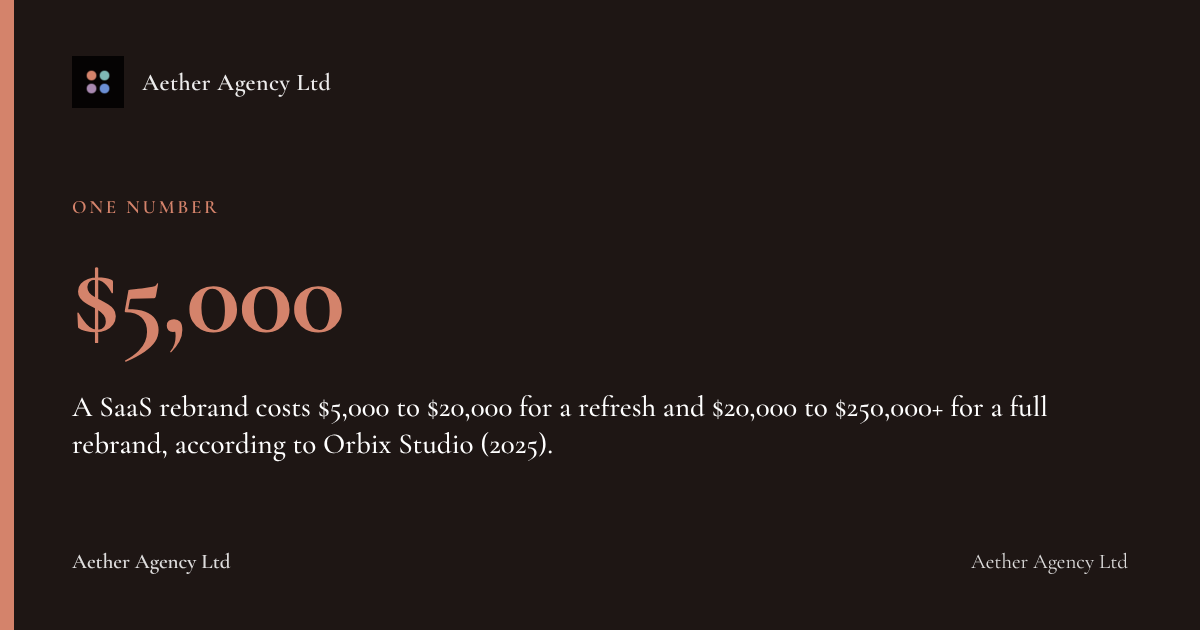
- A SaaS rebrand costs $5,000 to $20,000 for a refresh and $20,000 to $250,000+ for a full rebrand, according to Orbix Studio (2025).
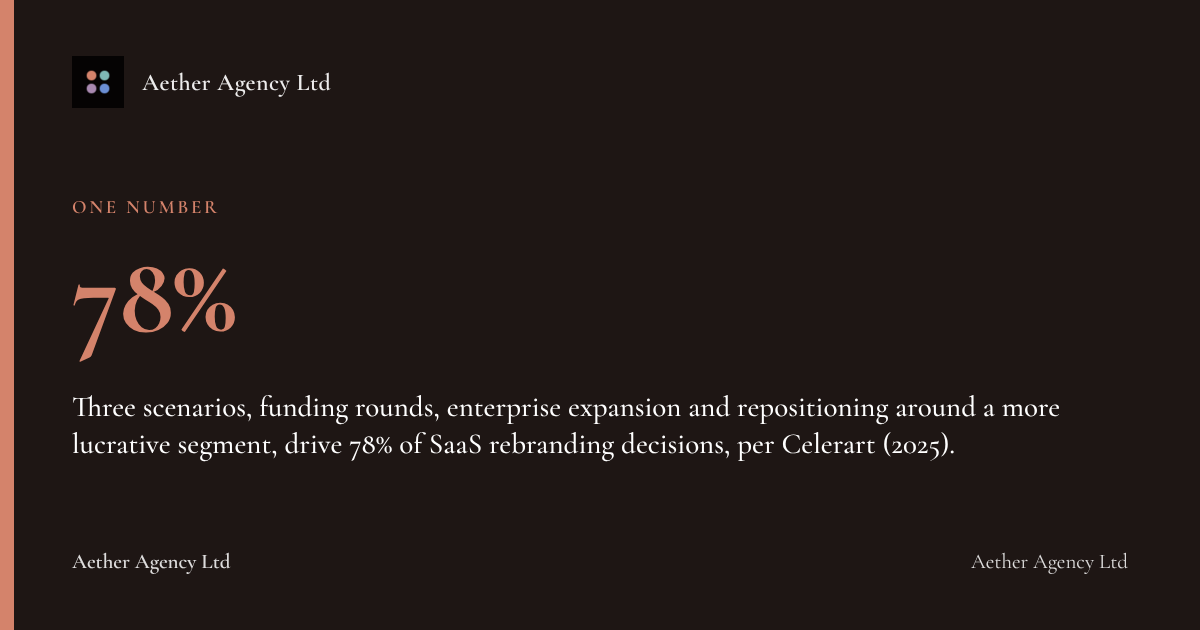
- Three scenarios, funding rounds, enterprise expansion and repositioning around a more lucrative segment, drive 78% of SaaS rebranding decisions, per Celerart (2025).
- A Series A B2B SaaS rebrand saw branded search up 45%, win rate up 5 points and NPS up 9 points within six months, according to Utsubo (2026).
- 82% of marketers have personally worked on a rebranding project, per Amra & Elma (2026).
- Coordinated launches lift brand awareness by 19% within six months, against just 9% without coordination, according to Amra & Elma (2026).
What Are the Main Reasons a SaaS Company Decides to Rebrand?
A SaaS rebrand is a strategic response to a mismatch between what a company now does and what its name, look or messaging still says it does. Celerart (2025) reports that three scenarios account for 78% of SaaS rebranding decisions: preparing for a funding round, entering enterprise markets after proving product-market fit, and repositioning after finding a more lucrative customer segment than the one the company started serving.
Each trigger carries different urgency. A company raising a Series A or Series B often needs a brand that signals category leadership to investors and enterprise buyers in the same breath, well before the round closes.
A product that started as a scrappy tool for small teams but now closes six-figure enterprise contracts faces a credibility gap: procurement teams at larger firms expect polish that a founder-era logo rarely delivers. Celerart (2025) documents one case where repositioning around operational efficiency and field-to-office communication increased enterprise trial-to-paid conversion by 34%, a direct result of messaging catching up to the buyer the product had actually started winning.
Mergers, acquisitions and simple name collisions add further pressure. A UK SaaS firm expanding into the US or EU may discover its name is already trademarked, forcing a rename regardless of appetite.
What Are the Key Steps in Rebranding a SaaS Company From Start to Finish?
Rebranding a SaaS company follows a sequence: audit, strategy, identity design, legal clearance, build, and phased rollout, each gating the next. Skipping the audit stage is the single most common reason rebrands run over budget, because teams discover brand debt (old collateral, inconsistent naming, undocumented integrations) only after design work has already started.
The typical sequence looks like this:
- Audit the current brand across marketing, product UI, documentation, sales decks and third-party listings.
- Define the strategic reason for change and write it down as a one-page brief, tying it to the business goal (funding, enterprise entry, repositioning).
- Research the competitive landscape and run trademark searches before any name is shortlisted.
- Develop the new identity: name (if changing), logo, colour system, typography and tone of voice.
- Build the legal and technical foundation: Companies House filing, domain acquisition, SSL and redirect planning.
- Roll out in phases: internal team first, then product UI, then marketing and public channels.
- Monitor and measure branded search, win rate and customer sentiment for at least six months post-launch.
Aether Agency Ltd's work with Renton Dance Studio illustrates the audit-to-identity sequence in a smaller, parallel case: the studio's traditional digital presence was failing to connect with a younger audience, so Aether Agency Ltd delivered a complete rebrand, website redesign and social content programme, moving the brand and website from traditional to modernised. The same audit-first discipline applies whether the client is a dance academy or a SaaS platform: you cannot design a new identity sensibly until you know exactly what the old one touches.
How Long Does a Typical SaaS Rebranding Project Take?
A SaaS rebrand typically takes three to nine months from initial audit to full public launch, with the range driven almost entirely by scope rather than company size. A brand refresh, new logo, refreshed colour palette, updated messaging, can often launch in eight to twelve weeks.
A full rebrand involving a name change, new domain, product UI overhaul and legal filing routinely takes six to nine months when you include the quieter post-launch phase: updating every app store listing, every integration partner's directory entry and every piece of legacy documentation. Utsubo (2026) tracked outcomes at the six-month mark for a Series A B2B SaaS company, which is a reasonable minimum horizon for judging whether the new positioning is landing with branded search, win rate and NPS all moving in the right direction by that point.
Rushing the legal and SEO groundwork to hit an internal launch date is the single biggest cause of projects over-running later, because teams then have to pause the public rollout to fix trademark conflicts or broken redirects.
How Much Does Rebranding a SaaS Company Cost in the UK?
Rebranding a SaaS company costs anywhere from $5,000 for a light visual refresh to $250,000 or more for a full enterprise-grade rebrand, according to Orbix Studio (2025). The figure scales with company stage: a seed-stage startup refreshing its logo and colour palette sits at the low end, while a scale-up changing its name, rebuilding its website and retraining its sales enablement materials sits at the top.
| Scope | Typical cost range (USD) | What's usually included |
|---|---|---|
| Brand refresh | $5,000 to $20,000 | Logo update, colour and type refresh, messaging polish |
| Mid-scale rebrand | $20,000 to $80,000 | New identity system, website redesign, launch campaign |
| Full enterprise rebrand | $80,000 to $250,000+ | Name change, trademark clearance, product UI overhaul, multi-channel rollout |
Source: Orbix Studio (2025).
UK businesses should budget separately for Companies House filing fees, UK and EU trademark searches through the Intellectual Property Office, and domain acquisition, none of which are included in typical design-agency quotes. A brand refresh rather than a full rebrand is often the sensible first move for a company that has strong product-market fit but a tired visual identity, since the cost difference between the two tiers is substantial.
Who Should Lead a SaaS Rebrand: Marketing, Leadership or an External Agency?
Leadership should own the strategic decision to rebrand, while a specialist agency or in-house brand team should own execution, because the two require different skills and different levels of objectivity. A chief executive or founder sets the business reason (funding, market entry, repositioning) and approves budget and timeline, but should rarely be the one judging logo concepts.
The comparison below sets out where each option tends to work best:
| Approach | Best suited to | Trade-off |
|---|---|---|
| Fully in-house | Companies with an existing brand/design team and deep institutional knowledge | Can lack objectivity; internal politics slow decisions |
| External branding agency | Companies needing fresh strategic thinking and a dedicated identity system | Requires budget and a clear brief; agency needs onboarding time |
| Hybrid (agency + internal lead) | Most mid-sized SaaS companies | Needs one internal owner to keep the agency aligned with product reality |
Cuneyt Buyukbezci, Chief Marketing Officer at Appnomic, puts it plainly: "Re-branding, or at least consideration of such, should be an integral part of a pivot or strategic shift process." That framing matters because it places the rebrand decision inside the same room as product and go-to-market strategy, not as a cosmetic afterthought handed to marketing once everything else has been decided.
A hybrid model, one internal product-literate owner working alongside a specialist branding agency, consistently outperforms both extremes for mid-sized SaaS companies, because it combines outside objectivity with inside knowledge of what the product actually does. Aether Agency Ltd works this way as standard through its Brand Identity service: naming, identity systems and guidelines built to survive every channel the product touches, from the marketing site to the in-app settings screen.
What Legal Considerations Apply When Changing a SaaS Company's Name?
Changing a SaaS company's name involves at least three separate legal checks: a UK trademark search, a Companies House filing, and a review of existing commercial contracts that name the old entity. Skipping any one of these can force a second, unplanned rename months after public launch.
UK trademark clearance. Run a search through the Intellectual Property Office before shortlisting names, covering both the UK register and, if the company sells into the EU, the EUIPO register. A name that clears a basic Google search can still infringe a registered trademark in a different sector, a risk a specialist IP solicitor is best placed to assess.
Companies House filing. A UK limited company changing its registered name must file the change with Companies House, typically by special resolution, with the new name appearing on the public register once approved. Aether Agency Ltd itself is a registered company (incorporated 3 June 2020, Companies House number 12641621), so this filing step is a routine part of UK corporate life rather than an exotic hurdle.
Contracts, domains and data processing agreements. Existing customer contracts, data processing agreements and supplier terms that name the old legal entity may need formal novation or amendment, particularly for enterprise customers whose procurement and legal teams will flag a name mismatch automatically. Domain registration should move in parallel, ideally with the new domain secured and verified weeks before any public announcement.
How Should SEO and the Website Be Handled During a SaaS Rebrand?
Aether Agency Ltd advises preserving search rankings through 301 redirects, a careful domain migration plan and Google Search Console monitoring, because search visibility built over years can evaporate in weeks if the technical migration is rushed. The safest approach keeps the old domain live with permanent redirects to equivalent new URLs, rather than a blanket redirect to the homepage, which loses most of the ranking value of individual pages.
A sound SEO migration plan typically covers:
- Mapping every indexed URL on the old domain to its equivalent on the new one before launch.
- Setting up 301 redirects (never 302s, which signal a temporary move) at the server level.
- Submitting the new domain and an updated sitemap through Google Search Console.
- Updating internal links, canonical tags and structured data to reference the new domain.
- Monitoring branded search volume weekly for the first three months post-launch.
Utsubo (2026) recorded branded search up 45% within six months for a Series A SaaS company following its rebrand, a reminder that a well-executed rebrand can grow search demand rather than just preserve it, provided the technical migration doesn't choke off existing equity first. Aether Agency Ltd's AI Search Marketing (GEO) service exists specifically to manage this handover: generative engine optimisation and citation tracking alongside traditional Google visibility, so a rebrand doesn't quietly undo years of ranking work the moment the new domain goes live.
What Mistakes Do Companies Most Commonly Make When Rebranding a SaaS Business?
The most damaging mistake is explaining the product in internal, engineering-led language rather than the words a buyer actually searches for. Deepak Shukla, CEO of Pearl Lemon, has noted that "the biggest branding failure in SaaS is still companies explaining their product in the internal language their own engineers use", a trap that a rebrand should fix rather than reinforce with a shinier logo on the same confusing copy.
Other recurring mistakes include:
- Treating the rebrand as a design project rather than a strategic one, skipping the audit and positioning work entirely.
- Launching without coordinating marketing, product UI and sales collateral, which Amra & Elma (2026) found produces only a 9% brand awareness lift, against 19% for coordinated launches.
- Redirecting an entire old domain to a new homepage, destroying page-level SEO equity in the process.
- Underestimating internal change management: one rebranding commentator cited via Celerart (2025) argues that "if your rebrand doesn't make at least 20% of your team uncomfortable, you're not changing enough," a useful signal that genuine repositioning should feel uncomfortable, not just look different.
- Forgetting third-party surfaces: app store listings, integration marketplaces (Zapier, Slack App Directory), and partner co-marketing pages that still carry the old name months after launch.
How Do You Measure Whether a SaaS Rebrand Has Been Successful?
A SaaS rebrand's success is measured through branded search volume, enterprise win rate, average deal size and customer retention, tracked for at least six months after public launch. Utsubo (2026) reports a Series A B2B SaaS company (roughly $8M ARR) saw branded search up 45%, win rate up 5 percentage points and NPS up 9 points within six months of its rebrand, a useful benchmark set for companies at a similar stage.
Enterprise-focused rebrands show up differently in the numbers. Celerart (2025) documents a rebranded SaaS platform where enterprise win rate rose to 29% (a 61% improvement), average deal size climbed from $32,000 to $48,000 (a 50% increase), while SMB customer retention held steady at 92%, demonstrating that a rebrand aimed at a new segment needn't damage the existing customer base if positioning is handled carefully.
Website engagement is a faster, earlier signal. Amra & Elma (2026) found that companies undergoing comprehensive visual rebranding (new logos, colour palettes and digital UI) saw dwell time up 29% and new customer acquisition up 21% on average, metrics that typically move within the first 60 to 90 days, well before win-rate and retention data has time to settle.
Your SaaS Rebrand Checklist
- Write a one-page strategic brief naming the specific business reason for the rebrand before any design work starts.
- Run a UK trademark search through the Intellectual Property Office before shortlisting names.
- File any company name change with Companies House and update every contract that names the old entity.
- Map every indexed URL to its new equivalent and set up 301 redirects before switching domains.
- Brief internal teams and update in-app branding and documentation before the public announcement goes out.
- Coordinate the marketing, product and sales launch so they land in the same window, not staggered weeks apart.
- Audit and update app store listings, integration marketplaces and partner directories within the first two weeks post-launch.
- Track branded search, win rate and NPS monthly for at least six months after launch.
FAQ
What is the difference between a brand refresh and a full SaaS rebrand?
A brand refresh updates visual elements like logo, colour and typography while keeping the company name and core positioning intact, typically costing $5,000 to $20,000. A full rebrand changes the name, positioning and often the domain, costing $20,000 to $250,000+, according to Orbix Studio (2025).
When should a SaaS company consider rebranding?
A SaaS company should consider rebranding when preparing for a funding round, entering enterprise markets after proving product-market fit, or repositioning around a more profitable customer segment. These three scenarios drive 78% of SaaS rebranding decisions, per Celerart (2025).
How do you communicate a SaaS rebrand to existing customers without causing churn?
Communicate well ahead of public launch, explaining clearly that the product, pricing and support remain unchanged even though the name and look are changing. Enterprise customers in particular need advance notice because procurement and legal teams must update contracts and internal records before the switch goes live.
How long does a SaaS rebrand take from start to finish?
A brand refresh can launch in eight to twelve weeks, while a full rebrand involving a name change typically takes six to nine months including post-launch cleanup of app stores, integrations and documentation. Utsubo (2026) used a six-month window as the minimum point to judge results.
Does a SaaS rebrand hurt existing customer retention?
Not necessarily, when positioning is handled carefully. Celerart (2025) recorded SMB customer retention holding at 92% even while a rebrand targeting enterprise buyers lifted win rate and deal size significantly.
What should be checked across app stores and integrations after a SaaS rebrand?
Every listing bearing the old name needs updating: app store entries, integration marketplaces such as the Slack App Directory or Zapier, partner co-marketing pages, and any API documentation referencing the old domain or brand name. These are easy to overlook because they sit outside the core marketing and product teams' usual workflow.
How much does a SaaS rebrand typically cost in the UK?
UK costs broadly mirror the figures reported by Orbix Studio (2025): $5,000 to $20,000 for a refresh and $20,000 to $250,000+ for a full rebrand, with UK-specific additions for Companies House filing and IPO trademark search fees.
Rebuilding Your Brand Identity With Aether Agency Ltd
Rebranding a SaaS company touches far more than a logo, and Aether Agency Ltd's experience taking Renton Dance Studio through a complete rebrand, website redesign and social content programme reflects the same discipline that a SaaS rebrand demands: audit first, design around a clear strategic reason, then roll out in a way that doesn't strand customers or search rankings along the way. The principles are identical whether the client is a dance academy modernising for a younger audience or a SaaS platform repositioning for enterprise buyers.
Aether Agency Ltd has delivered 50+ projects with a team carrying 20+ years of combined experience, building identity systems designed to hold together across every channel a growing business touches, from the website to the product itself.
If your SaaS company is weighing up a rebrand, get in touch with Aether Agency Ltd's Brand Identity team for a conversation about naming, identity systems and guidelines built to survive the whole rollout, not just the launch day.
Related Reading
- Rebranding a Startup in 2026: When and How to Do It
- Branding for Recruitment Agencies in a Crowded Market
- Branding for Security Companies: A 2026 UK Guide
Add aether-agency.co.uk as a preferred source on Google
See How Your Brand Appears in AI Search
Aether AI monitors your visibility across ChatGPT, Perplexity, Google AI Overviews, and Claude in real time. Find out where you stand and what to fix.
Explore Aether AI